Bishop Barron on empathy, Magnifica Humanitas Chapter 1, and an interview with Ed Hahnenberg
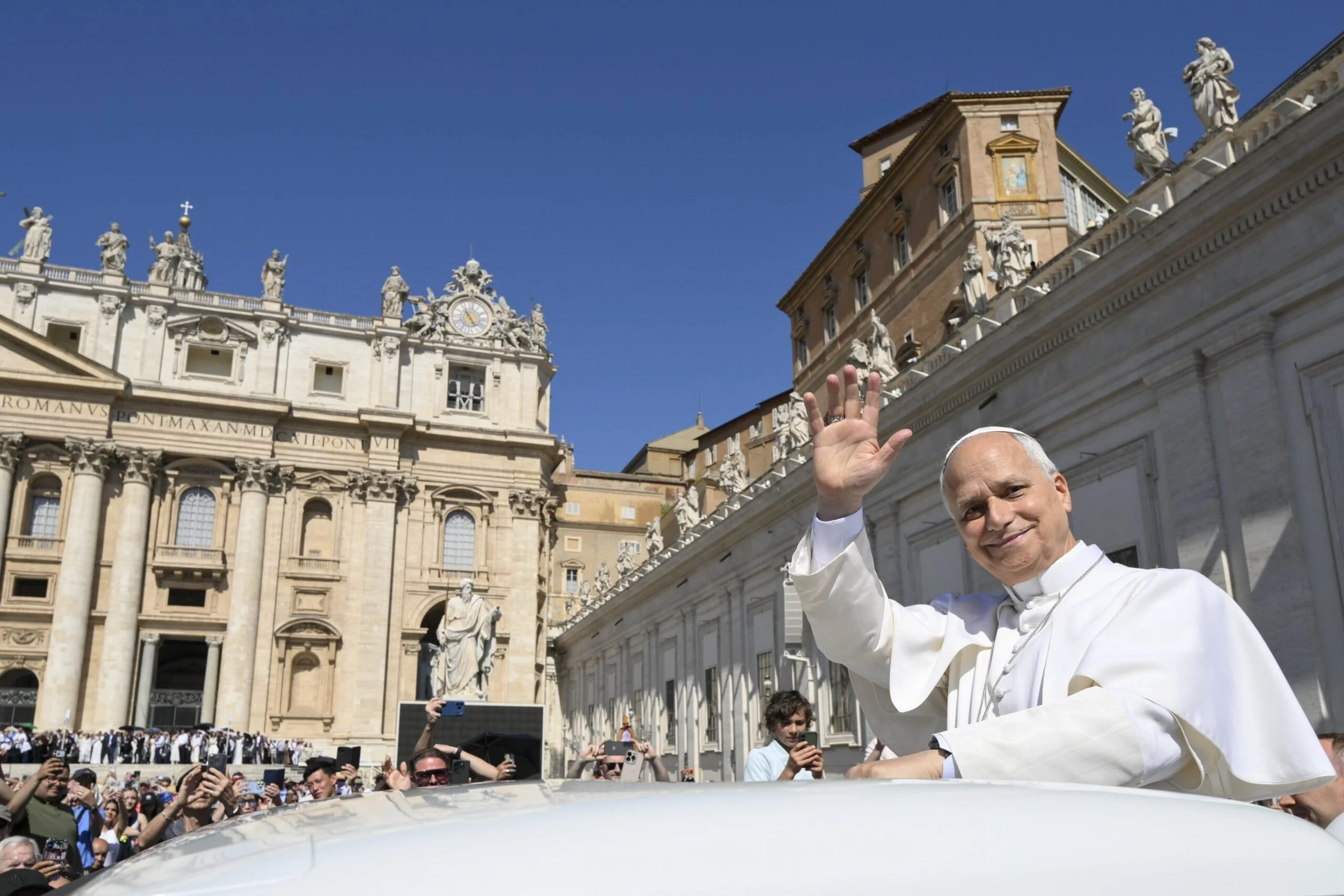
Heidi, Daniel, and David continue their explorations of the new papal encyclical, and they bring a critical eye to Bishop Barron's recent attacks on so-called "toxic empathy." Heidi brings us an interview with theologian and author Ed Hahnenberg about synodality and ministry.
INTRO
A busy fall for everyone
Heidi’s course at Loyola Chicago on Catholic Social Teaching
Heidi and Steven Millies on a panel at Loyola about “the new converts”
Heidi’s recent column for Commonweal on new converts
Jim Gaffigan at Notre Dame
Daniel’s book on the letters of Thomas Merton
Daniel’s book on the Holy Spirit
SEGMENT 1 - Bishop Barron on Empathy
NCR article on Bishop Barron’s recent criticisms on empathy
Magnifica Humanitas 25
Anti-evangelical, anti-Gospel
Philippians - God identifies with the poor
Empathy is related to compassion - to enter into the suffering of another
Pope Francis on the Beatitudes: “Blessed are those who mourn”
“The hard-edged language of love” is the language of abusers
Agape
Bishop Barron on the Theo Von podcast
What Do Their Deaths Demand? - recent book by Bishop Barron
Qui bono? Who benefits?
SEGMENT 2 - Magnifica Humanitas, Chapter 1
Magnifica Humanitas, Chapter 1
Gaudium et Spes
SEGMENT 3 - Interview with Ed Hahnenberg
TRANSCRIPT
===
DAULT: Hello, and welcome to The Francis Effect podcast. My name is David Dallt. I host a radio show called Things Not Seen about culture and faith, and I'm an associate professor of Christian spirituality and philosophical theology at the Institute of Pastoral Studies at Loyola University Chicago. I'm here with my two good friends, Heidi Schlumpf and Dan Horan.
Heidi is senior correspondent at Commonweal Magazine. She is also an award-winning journalist and part-time faculty member at Loyola University Chicago. Dan is professor of philosophy, religious studies, and theology at St. Mary's College in Notre Dame, Indiana. He is also a regular columnist at the National Catholic Reporter.
Every couple of weeks, we get together to discuss news and events through a lens of our shared Catholic faith. Heidi and Dan, welcome to you both. Heidi, how have you been?
SCHLUMPF: I've been busy. We've been talking just before we turned record on here about how the fall schedule is so hectic for all of us, and after sharing with our listeners what a nice, relaxing summer I had it feels like things have really ramped up now that school has started. Not just for my family you know, I have a husband who's a teacher and a senior in high school and a college student, but I'm also still teaching at Loyola University Chicago, so one class on Catholic social teaching, which we'll be discussing in the podcast.
And I have a wonderful group of students but it just makes life a little more hectic. I was lucky to be invited to be part of a panel with friend of the podcast, Steve Millies just this past Saturday, and the topic was about the new converts, which I wrote about for Commonweal magazine's October issue.
But we had a wonderful day-long event discussing this, especially talking about the rise in people entering OCIA on college campuses, and I'm getting ready to leave later today as we're recording this to head to the University of Notre Dame, my alma mater, for a couple events and interviews, and I hope to see Dan Horan in person briefly.
So Dan, how are you?
HORAN: I'm good. I'm looking forward to seeing you in person as well here in The Bend. It's yeah, crazy like everybody else, as you mentioned, Heidi, in the academic world but gener- generally good crazy. We're just finishing week four of our semester, which is actually really difficult to believe.
It's flying by. But really good classes. My students are always, as always, great. Here in Notre Dame, it's obviously football season, so that's the, you know, the big energy and talk of the town, and ND's off to a, a fairly good start, which is great. One cool thing since our last recording is that the comedian Jim Gaffigan was in town and performed at Notre Dame, and so my wife and I were able to go and see him perform, and that was really funny.
He's very funny, obviously. And yeah, some updates on book projects. I feel like I'm pulling the adult card here, giving you the manuscript updates. But my very long research project editing the correspondence between Thomas Merton and Naomi Burton Stone is on its way to publication, so that's exciting.
Should be out later next year. And I'm still working on this Christology book A History of Superlapserianism, which is looking at the divine ratio or motive for the incarnation independent of human sin. So there's this long 2,000-year-old tradition. It's very exciting and I hope that also sees the light of day next year, God willing.
So, David, I invo- invoked your name, the adult card as I put it. How are you doing?
DAULT: I'm doing well. Heidi and I are both here in Chicago, where we are currently seeing a precipitous drop in temperature. We were in the 90s a few days ago, and we're now in the 50s, and we have nearly 100% humidity. So it is a very weird, clammy, sort of, Wuthering Heights kind of day here. And like you, I have been busy teaching.
We are also in our fourth week, and the classes that I'm teaching are going very well. The students are responding to the weirdness that I bring to these issues of spirituality, so that's always fun to see come together. Like you, I have some writing projects that I'm putting out into the world. I have proposals for a book on materialism out, and I've-- I'm s- I'm working on a, a proposal for a book on spirituality and a book on synodality, and these all feel like good very energetic projects, which is always fun.
It's good to write things that you want to write. But the real kind of nugget that has been on my radar in the last couple of weeks is from the other side of the classroom. Our oldest child is a senior and is doing college visits, and so we did a couple of college visits over the last couple of weeks, and it was very fun, really informative, found some really great options, but also exhausting, just the logistics of you know, driving for several hours and getting to a place and then doing tours and meeting with people and all of that.
But the most important thing is our kid is excited about college, and so we're just happy about that and what might be on the horizon for them in the years to come. Speaking of on the horizon, let's talk about what's gonna be happening here on the show today. So in our first segment, we're gonna be looking at some recent comments by Bishop Robert Barron of the Diocese of Winona-Rochester on empathy, particularly his criticism of toxic empathy, and we're gonna use that as a jumping-off point to some wider issues of Bishop Barron and his ministry.
In our second segment, we're continuing our series of digging deep into Magnifica Humanitas. We're gonna be doing chapter one in segment two. And then in segment three, Heidi has an interview with Ed Hennenberg, who is a theologian from John Carroll University, and they're gonna be speaking about synodality and ministry.
All that is coming up here on the Francis Effect podcast. We're so glad that you are here with us. We're gonna take a short break, and we'll be back in just a moment.
SEGMENT 1
HORAN: Welcome back to The Francis Effect. I'm Dan Horan, and I'm here with David Dolt and Heidi Schlumpf. Every couple of weeks, we get together to discuss a variety of topics from a perspective informed by our Catholic faith. Bishop Robert Barron of the Diocese of Winona-Rochester in Minnesota has recently been appointed to serve on the United States Commission of International Religious Freedom.
Bishop Barron has already been serving on the Religious Liberty Commission, which focuses on domestic policy. These appointments make Bishop Barron among the most visible and central religious leaders in the current Trump administration. Listeners will probably also be familiar with Bishop Barron's long tenure as the founder of Word on Fire, a Catholic-focused media ministry and publishing company that he started when he was serving as a priest in the Archdiocese of Chicago.
He produced and was the host for the very popular television series Catholicism for PBS, and has gone on to produce and host a variety of video, podcast, and print resources on ecclesial and cultural issues. Recently, Bishop Barron has become a very visible critic of the Democratic Party, as well as so-called woke cultural issues.
Through Word on Fire, he has platformed a number of figures on the cultural right and far right, including Ben Shapiro and Jordan Peterson, and he has praised the late Charlie Kirk as, quote, "An apostle of civil discourse," unquote. One of the figures that Bishop Barron has promoted is Gad Saad, a marketing professor at the University of Mississippi and the author of the book Toxic Empathy. As noted recently by the National Catholic Reporter, Bishop Barron said in a YouTube video posted on September 6th, quote, "If you put empathy so defined in the center of your preoccupation, truth, reality, justice, and love are going to be threatened," unquote.
But many Catholics, including Pope Leo XIV, have taken a different view, asserting empathy as a central aspect of a healthy Christian faith. Again, as NCR has reported, Pope Leo made remarks this past May in which he lent his support for empathy saying, quote, "Human compassion and empathy are not something additional or optional, but are a call from God to reflect his goodness in our daily lives." unquote. David, I've focused on empathy here in this introduction, but you have mentioned to me that you see this as part of a larger set of issues surrounding the ministry of Bishop Barron.
So why don't we start there? Could you tell us about that?
DAULT: Sure. And I want to frame my remarks here in light of something that we're gonna be discussing later in the program, and that is this encyclical Magnifica Humanitas. And in paragraph 25 Pope Leo lifts up and notes that Saint Pope John Paul II invited us to examine honestly the times when acquiescence was given to, quote, "intolerance and even the use of violence in the service of truth," unquote.
And that's really the, the framework that I want to give to this attack on empathy. Because I think that Bishop Barron is part of a long-standing Christian tradition a, a group of people that come into the Christian faith because it gives them an opportunity to find ways to do violence against others to create isolation, to create feelings of distrust, to create even sources of attack.
And so when we are looking at his criticism of empathy and this kind of wider conversation, I don't think that anyone looking at the late 20th century and early 21st century is gonna look at the Catholic Church and say, "They have just been too nice. They have just been too empathetic to the vulnerable."
And in fact, this is not just Pope Leo, but Pope Francis before him criticizing the Church for failing to go, as Pope Francis would say, beyond the streetlights into the spaces where those that have been maligned by the Church, those that have been left behind by the Church, those that have been harmed by the Church are living their lives and trying to have their existence and to create something that we might call flourishing.
And so if it sounds like I'm being critical of Bishop Barron here, I am, because as we have noted in passing in comments in the past here on the Francis Effect, it is so often that Bishop Barron will be in the midst or even in the center of a real kind of cultural maelstrom. Let's just take some random examples.
Trans people not being able to go to the bathroom, or people being literally rounded up off of the street here in America and put in concentration camps, some of them being killed or dying in malign ways. And he finds instead an issue of kind of cultural currency, and he focuses on that, and he makes that the thing that he wants to point his very large spotlight on And so, you know, I can't speak to his intentions, but I can speak to the consistent pattern here of his unwillingness to actually listen to the popes and even to the current pope on this issue, and instead to sort of set himself as a kind of paragon of the truth of the Catholic faith.
But the truth of the Catholic faith, as I've often said on social media, kinda splits in two ways. There is a Catholic tradition that aims at incarceration and violence, and there's a Catholic tradition that aims at liberation and flourishing, and everything else is just public relations. And I fear that Bishop Barron has moved from public relations to being firmly on the side of the church of incarceration.
So those are my initial comments. I'd love to hear what you all think.
SCHLUMPF: Yeah, well, not only is Bishop Barron not seeming to be reading or listening to or quoting the recent popes on this, he's out of step with the other US bishops. And so it's just interesting to me that he continues to wage this culture war on the right, you know, being more interested in referring to marketing professors who are you know, trying to attack people on the left when the rest of the bishops are, dare I say, expressing empathy with some of the many people who are suffering in our country today.
So the number of bishops and not just bishops that you might think would be speaking out about this, are talking about the violent immigration enforcement. The current president of the USCCB writing a letter to Donald Trump asking him to stop deporting Haitians and restore temporary protective status to them.
Bishops expressing concern about the massive cuts to USAID aid that are leading to the deaths of hundreds of thousands, if not millions of people. You know, I wanna give Bishop Barron the benefit of the doubt, and I know he quotes Aquinas in talking about willing the good of the other. I'll let you more PhD theologians g- dig into that if you'd like.
And I s- I think there are times when empathy can be a mask for doing what's right. But more often, I think this kind of criticism of empathy can be a mask for just being selfish. And I just think that's much more likely to-- is what we're seeing right now. And I don't think separating children from their parents, putting people in cages and basically concentration camps and denying them medical care where ma- many of them are dying, shipping people in the middle of the night to a dangerous country they've never lived in, this is not willing the good of the other, in my opinion.
HORAN: Yeah. I mean, it's hard to read this position on, quote-unquote suicidal empathy and Barron's embrace of it as anything other than anti-evangelical, anti-gospel. Some of this language that, like, Saad write, writes in his book, quote, "A society dies when it cares more about exhibiting infinite tolerance and empathy than invoking its survival instinct," unquote.
This is a kind of line of reasoning that people like Elon Musk and others have taken on and have embraced in a very distorted way, a kind of survival-of-the-fittest in a social kind of setting, which By definition is exclusionary and dehumanizing, right? So a- against whom are others evaluated, you know?
It- to talk about the survival instinct seems antithetical to, to the Christian tradition. Philippians makes clear that God identifies with the poor, the marginalized, those who are identified in society as the least. You know, the language that's used in the New Testament is as a slave, so that God empties God's self to take on this lowliest position.
Not only that, the whole ministry of Jesus in the Gospels is one of solidarity with those who are suffering, with those who are at the margins, with those who do not fit or belong, et cetera, et cetera. And so Barron's, identification of what he calls wokeness with empathy is really disturbing on just the, on the face value.
The second thing I would say is etymologically he should know better, that empathy is a relatively recent word in English. It's about 100 years old, but its root word is the same as compassion or compassio in Latin, this idea of suffering with another, and empathy means to enter into the suffering.
And I'm here thinking about one of Pope Francis's apostolic exhortations when he's talking about holiness, and he has this long gloss on the Beatitudes. And one of my favorite parts of that is a passage about, "Blessed are those who mourn," which is d- without a doubt probably the most paradoxical of the, the kind of Beatitudes that Jesus preaches.
You know, 'cause why... You know, we associate mourning and sadness and this sort of thing as, as an, as a thing to avoid, as a negative thing. But in his reflection, the late Holy Father makes clear that what Jesus is calling for is exactly what the Hebrew prophets had also said, you know, invoking the word of God, which is too often we move through the world with hard hearts, with stony hearts, incapable, unwilling to open ourselves up to the empatheos, to enter into the suffering of another, to be compassionate, to walk with and suffer with another.
And so what I see here is, Heidi, I would agree with you, not only kind of a selfishness but it's an anti-Christian message, quite frankly, and I mean that in the most literal way. I... There's nothing in Jesus's ministry preaching that makes clear that this is a legitimate way to understand the Christian tradition or the, the discipleship that we're all called to through baptism.
Instead, we're called to suffer literally, right? To ta- to take up our cross to lay down our lives for our friends, for our neighbors, to love our enemies as ourselves. So it's not even empathy, and it's not even compassion. It's not even mourning for those we like or love, but those that we identify as our enemies or who are different from us or who are, you know, maybe what Barron would call those who would fall under the woke umbrella
DAULT: Well, and I just wanna pick this up. I really came out swinging there at the top, and I want to play devil's advocate for just a moment and see if I can get into the mindset here. So what is the logic that would allow Bishop Barron to follow Gad Saad in, in this trajectory of thinking? And the best that I can imagine is that we're thinking of dignity and empathy as kind of finite resources.
And in that sense, it falls into the logic that we're seeing at the highest levels of the political administration in this country right now. We only have so much, and it should just go to the right people. It should go to the Americans. It sh- it should go to the good people. It should go... It shouldn't go to the, and again, using the language of Donald Trump, it shouldn't go to the shithole people.
Okay, so if that is the mindset, and if you have the mindset that, that dignity and empathy are limited resources, and they only need to go to certain people, well, then you're going to build borders and walls, and you're going to want to have a kind of limited economy. But the whole point of dignity, and the whole point, I would say, extending from that to the idea of empathy, is that the more dignity that you put into the world, the more dignity that there is.
It's not a limited resource. It's a constantly renewable resource if you simply start the process. And Dan, you've already alluded to this. When we love our enemies, we offer them a dignity that they may not be offering to us, but nevertheless, it is a dignity that is commanded both by our Lord Jesus Christ, but also by the simple fact that they also are created in the Imago Dei.
God makes the rain fall on both the just and the unjust. And so we have a mandate to actually expand our empathy and to actually find ways to expand our hearts and to expand the idea of how we would even share resources that follows from all of this, but it's a completely different mindset than the one that we're seeing when the approach is, oh, all of this is just a limited resource.
HORAN: Yeah. In that NCR article I mentioned at the top of this segment the reporting reflects from that video where Barron is talking about this. He says at one point, quote, "We need, I think, to reassert with biblical boldness that what stands at the center of our society is not refraining from hurting people's feelings, but is the kind of hard-edged language of love."
End quote. I find this really disturbing on a number of levels. One, this is the kind of language that abusers use. I'm talking about domestic abuse, I'm talking about parental abuse, I'm talking about all kinds of things in which people say, "I'm giving you, quote unquote, 'tough love.'" And that's the language Barron's using here, right?
Hard-edged language of love. Now, Jesus talks about tough love a lot. In Greek it's called agape. Agapic love is difficult, it is challenging, but not for those we love. It's for those who are doing the loving. It's the internal conversion. It's the self-sacrifice, the hard, difficult process of moving beyond our own selfishness, our own borders, our own barriers, our own preconceptions and judgments to embrace the other.
It's not l- it's not loving to tell somebody that they're less than. It's not loving to exclude people from the table of God's communion, which all are invited to. It's not loving to tell people that they're intrinsically evil. What's loving is to examine one's own conscience, to soften one's own heart as, I would say, with biblical boldness the Hebrew prophets and Jesus himself demonstrated.
So there is a s- there's a real distortion I see in this kind of, you know... it's sort of like a parable of Jesus' parable. If Jesus' parabolic preaching is flipping expectations upside down, then what I hear Bishop Barron doing here is taking Jesus' parables and flipping them upside down one more time back to a distorted sense of relationship.
So I'm very concerned about this, because he does have a large platform. He was just this past week on an even larger platform, which is the comedian Theo Von's podcast. You know, he's oftentimes grouped with people like Joe Rogan and Call Her Daddy and some of these other very popular cultural phenomena.
So I do worry about this, and I think it's troublesome
SCHLUMPF: And well, just piggybacking on that, Dan, too, what I noticed is this excessive emphasis on willing the good of the other in which you decide what the good of the other is a certain kind of, you know, theology or spirituality that you see among religious people, often evangelical Christians.
And, you know, it is true that sometimes someone more steeped in the tradition might have something to share with another person who needs to hear about something they need to work on. But this is excessive focus on judging other people and what's good for them, as you mentioned, is a slippery slope and can be very dangerous and even abusive.
And I think about of all the things that Bishop Barron could be using his platform for to talk about, it's interesting to me that this would be one of them, like excessive empathy. And it's so clear when you see how this has become a buzzword and, like, the new argument in right-wing circles like you mentioned, used by Elon Musk, J.D.
Vance and other folks. You can see that, choosing this topic to speak about is further painting him as more aligned with, like, the Trump administration than, you know, with his own popes who he's not quoting. And you know, to see that he was just recently appointed to the International Religious Liberty Commission, you know, bravo.
The, our guest from last episode, Steve Schneck, was also on that commission in the Biden administration, and it's good to have Catholic voices in such a, such an important committee. But it does start to look like throwing his hat in with right-wingers has led to a number of opportunities for Bishop Barron, and that's concerning to me.
DAULT: I wanna pick up on that and this idea of opportunities, because just recently, Bishop Barron came out with a new book entitled What Do Their Deaths Demand? Christian Persecution Today. And so he's raising this issue of Christian persecution on a global scale while he is sitting on an international commission of religious human rights in an administration that is contributing materially in so many ways to the persecution of Christians, both abroad, but also right here on our streets, where people who are standing up out of conscience, people who are trying to live the gospel and care for those are being either defunded by this administration or outright attacked or arrested.
And so will Bishop Barron use his very public position on these two commissions to actually speak truth to violence? Or will he become what my beloved professor Walter Brueggemann used to call a cleric for the empire a chaplain for injustice? And this is the real challenge that I think faces all of us right now as followers of Christ.
Will we reproduce a church of violence, and will we reproduce structures of violence, or will we find a way to actually bring, as you were saying, Dan the real care for the poor and making the poor the center of all of this and the poor in every sense?
HORAN: Well, and I think maybe one way to kinda summarize all the insights you were just offering, David is to think of the Latin question that is oftentimes used to smoke out conflict or conflicts of interest, which is cui bono, who benefits? And I think every time Jesus talks about what we are called to do when it's, when we're called to do the Father's will, it's about benefiting those who are most vulnerable and at the margins.
It's not about my personal benefit. And I think this language of empathy is toxic, this language of suicidal empathy, which itself is pretty extreme, right? I I don't even wanna open that can of worms right now, but this idea that somehow loving and caring for and suffering with others is a problem seems to benefit only me, my own interest, and my own time, and that seems to me antithetical, yet again, as I've mentioned earlier, to what the Gospel says at its core.
So again when Bishop Barron makes these kind of promulgations, I have to ask myself, "Who benefits?" And as we'll see in the next segment, when we look at Pope Leo's encyclical, he's asking this question through the lens of Catholic social doctrine, which is when we look at corporate policies and the development of artificial intelligence and the tremendous amounts of money that's at stake here, the question, "Who benefits?"
is really key
DAULT: Well, listeners, because Bishop Barron is such a visible figure, I'm certain that there will be occasion for us to return to this conversation, but for right now, we're gonna leave it here. We're gonna take a short break, and when we come back, as Dan was just saying, we're gonna take up our deep dive into chapter one of Magnificat Humanitas, so that's coming up here on "The Francis Effect" when we return. Please stay with us
SEGMENT 2
DAULT: Welcome back to The Francis Effect. I'm David Dalton, and I'm here with Heidi Schlumpf and Dan Horan. Every couple of weeks, we get together to discuss a variety of topics from a perspective informed by our Catholic faith. Earlier this year, Pope Leo XIV published the first encyclical letter of his pontificate, "Magnifica Humanitas," or "Magnificent Humanity," is focused on what the document's full title describes as, quote, "safeguarding the human person in the age of artificial intelligence," unquote.
given the significance of this new encyclical, the public interest in its contents and implications, and the timeliness of its subject matter, we at The Francis Effect podcast are doing something a little different this season and dedicating a portion of each episode to unpacking and discussing this church document.
As we continue to explore this document, we invite listeners to read these sections and follow along with our discussion. We also welcome your engagement on social media. Please feel free to share your own thoughts and questions about the encyclical on our Facebook and Instagram pages. This week's segment focuses on Chapter 1, paragraphs 17 through 45, which situates "Magnifica Humanitas" within the broader framework and history of Catholic social doctrine.
In particular, Leo emphasizes the importance of the Second Vatican Council, especially Gaudium et Spes, the pastoral constitution on the church in the modern world, in mandating that Christians be attentive to and interpret the, quote, "signs of the times," unquote, in light of the gospel. In paragraph 22, Leo quotes Gaudium et Spes writing, quote, "It is the task of the whole people of God, particularly of its pastors and theologians, to listen to and distinguish the many voices of our times and to interpret them in the light of God's Word, in order that the revealed truth may be more deeply penetrated, better understood, and more suitably presented," unquote.
Dan, as a Catholic theologian, you fit the targeted audience that this section of Gaudium et Spes addresses, So help set the stage for us. What's in Chapter 1, and what are your initial thoughts?
HORAN: Well, I think you did a good job, David, giving the context that the primary purpose of this chapter is to situate what follows within the broader tradition of Catholic social doctrine going back in the modern era to Pope Leo XIV's own namesake, Pope Leo XIII, at the end of the 19th century. Listeners will recall that Leo XIII was engaging with a tumultuous cultural, social, economic context in which the Industrial Revolution was really dehumanizing people, right?
Where f- smaller and smaller percentages of the population were becoming incredibly wealthy, while the vast majority of people were living in these really close to subhuman conditions, and where labor was used to essentially crush the human spirit, right? And so in the age of AI and it's just, I've been thinking in anticipation of this conversation, we've seen how since this document was published, the AI concerns have, have only risen.
This document isn't just about artificial intelligence it's worth remembering, and Pope Leo goes to great lengths to remind us of that in chapter one. But it's definitely the, the major factor. It's the kind of presenting issue, we might say. I'm thinking as well and maybe this is a good way for us to begin, and it's a good bridge from the previous conversation we had in segment one to this one, which is a passage that appears in paragraph 27, in which Pope Leo writes, quote, "When the dignity of our brothers and sisters is violated, when politics fails to address the tragedies of humanity, when the economy turns against the person or science oversteps the limits of its competence, the Church, together with other Christian denominations and believers of other religions, must make her voice heard, not in order to dominate, but to promote communion."
And then he says, "Understood this way, social doctrine becomes a theology of communion in history, a history in which the Word made flesh continues to be present through dialogue, memory, and prophecy." Unquote. And I think there are several things there worth noting, that this is, again, unsurprisingly sort of the polar opposite of what Bishop Barron has been preaching, as we discussed earlier.
And we could talk about that. But the other thing that's really striking to me is this notion of social doctrine becomes the theology of communion in history. And he turns then to talk about the incarnation, that God takes on flesh, a vulnerability, and demonstrates in Jesus's earthly life and ministry that vulnerability is what it means to be divine.
It is what it is to exercise God's will, is to open oneself up to the care of another. And what Pope Leo is saying here is that there are times in which other domains of life fall short or maybe are stymied by self-interest or by profit or by greed or by power. Again, see discussion in segment one.
And in those moments, the Church has a responsibility as a moral compass of sorts to remind us of who and what we're called to be and what we are called to be for others. And so I think that's a really important kind of launching point for this whole encyclical letter. And I'm interested to hear what you two have to say.
DAULT: Well, one thing that I want to pick up on to expand on this analysis that you've started here, Dan, is something that rings through here, and I just have to say this chapter was wonderful for me because it is such a, a, a good, succinct, clear introduction to the entire tradition of Catholic social teaching, and it really lays out the pieces and what's at stake and what isn't being done in Catholic social teaching in such a clear way.
The piece that I wanna pick up on is kinda twofold. One, there's a refrain that happens at several points in this chapter where we are reminded that the, the work of the church is not the work of politics, that there's a proper domain of the kind of secular political realm, which is aimed towards the common good, and there is the proper realm of the church, which is not to interfere with the political realm in the secular world, but instead to constantly be a reminder and a conversation partner with those secular mechanisms to help them see the importance of the dignity of every person and the centrality of the common good to the labor of what we're trying to do.
So for me, that ringing through again and again is so important. The distinction here between what we might see in some Catholic commentators a desire for the Catholic Church to sort of come in and overtake politics, one type of integralism, is really being rejected here in, in this reading of the Catholic social tradition, which I very much appreciate.
And then, Picking up on that, the notion as well that we are not the kind of gatekeepers of the truth as a commodity, but rather that the truth is something which is discovered together in dialogue, and that's the other piece that rings out here again and again, that the church is not positioning it- itself into a space of command, but instead is positioning itself into a space of kind of context and hyperlocality.
Let me explain what I mean by that, because again when we have commentators who take a more kind of integralist position where they want to have the church be the dictator of all moral truth, those moral truths tend to be kind of axiomatic. They float above history. But a refrain that happens again and again through this chapter is no, every single location is going to have its own approach to this, and the church can't provide a one-size-fits-all answer to these questions that are so local and so individuated from place to place.
Instead, the church has to support the process of people actually speaking up for themselves, interrupting, and in some ways reinterpreting what is the kind of axiomatic truth at the encyclical or the magisterial level into a space where it will make sense for that particular community. To the extent that we can emphasize that kind of integralism, a more ecological integralism, where the biome of one area of the earth is gonna
be different from the biome of a, of another area of the earth, and the population of these different biomes are gonna have different resources, different ways, different approaches, to the extent that we can maintain that, we can have, I think, a really properly Catholic integral approach. To the extent that instead, echoing Cardinal Sarah, we just want to be a church that teaches but never listens then we are, I think, falling into the trap of a kind of command and violent Christianity that is so rightly interrogated here in this chapter.
SCHLUMPF: Well, thank you for that, David, for starting to dive into that issue of what is the proper role of the church's involvement in these social issues. I just wanna take a step back and once again thank Pope Leo for writing this document. It's really been helpful to me as someone who teaches Catholic social teaching to college students, and we've already used in my class chapter two, which we'll be discussing in the next episode where Pope Leo starts talking about some of the principles of Catholic social teaching.
But this history is also super helpful. I'm like, oh, I can update my PowerPoint slides and just maybe have them read this chapter as well. Because it is y- while brief, you know, and I encourage our readers to read it because it's not, you know, a whole book, which there's also whole books written about the history of Catholic social teaching, but it does show the consistency with which this has been taught.
And so it's not just, you know, the current, the popes that you agreed with or the popes that you like or some sort of newfangled, quote unquote, woke thing that, you know, the Democratic Party has picked up in the last 10 years or something. But I think you're right, David, in that it's not just history for history's sake.
It's also then going... You know, he's, he's leading us on this journey to the later chapters that are going to really challenge us as Catholics and Christians in this time to say, what is our role? How do we take these principles and this history and say, you know, and like you said, in a dialogical listening sort of way, discover what our faith can do to help us with these, as you say, Dan, admittedly very scary warnings that are starting to come out in the last couple weeks.
I have been trying to not read every single, you know, tech guy that writes an article in a major newspaper saying they're all coming to kill us because it... I feel like it might contribute to my anxiety level. But if ever there was needed a voice of moral authority and serious engagement with the signs of the times, it's now
HORAN: I think it's also interesting to see the humility with which Leo frames the development of Catholic social doctrine, Catholic social teaching. In paragraph 25 it's the f- opening of a section, a subsection here in this chapter titled Social Doctrine as a Shared Discernment, and I really...
I'm just gonna share the opening two lines here 'cause I think it's really, a- again, places a contrast against some of the stuff we talked about in segment one of this episode, but also that we see in popular culture and in broader society and in the church today. So he reminds us, and I quote, "Understanding that the truth is a gift to be shared, not a possession to be monopolized, frees the Church from the temptation of seeking forms of presence based on power.
In order to rediscover the evangelical approach of a gentle proclamation of truth that is not imposed, St. John Paul II invited us to examine honestly the times when acquiescence was given to intolerance and even the use of violence in the service of truth." End quote. That strikes me as quite different from what we discussed from Bishop Barron's own contemporary teaching on society and culture.
And the reason I'm lifting this up is because this is actually, yet again, as Leo has done in other contexts, encourages empathy, encourages not a kind of superficial tolerance, but a deep-seated, heartfelt openness to the experience, the reality, the pain and suffering, dare I say the joys and hopes, the griefs and anxieties of our neighbors and of you know, what the gospel would sometimes call strangers, right?
That we are called to love and to care for. So I think there's a way in which we can reduce this to an abstraction or we can reduce this to a touchy-feely sort of thing, and I hear that in Bishop Barron's sort of commentary. There's nothing touchy-feely about this. It's actually profound. It's simple, and oftentimes those things which are most simple, like the Gospel call to love God and love one's neighbor, are the most challenging of things.
SCHLUMPF: I was just gonna point out too that in addition that the structure of this chapter does kind of for a while there go pope by pope, and it's clear he's intent on hitting every single one. But there's also a little diversion to some Vatican II documents, and I think this just reaffirms the importance for his papacy and for the whole church the main teachings of the Second Vatican Council.
So many of our listeners probably know he's doing a series of teachings with his Wednesday audience talks as well, where he's going through the documents of Vatican II. And it's just- it's helpful for me to see how this all fits together with that part of church history as well. And I- it feels to me like a bit of, you know, Bishop Barrett- Barron notwithstanding, a bit of a resurgence of that spirit of Vatican II that was happening during the council, immediately after the council, kind of resurging with church leaders, everyday Catholics seeing the importance of Catholic social teaching, learning more about it, and thinking about how it applies to the issues of our day.
A piece I wrote for Commonweal recently had the headline, "Catholic Social Teaching is Having a Moment," and I think that's true, and I also hope it continues to grow.
DAULT: I wanna ask you both a question, because as I was reading through this and preparing for our conversation today, something struck me, but I'm not sure if my radar is tuned correctly. You mentioned, Heidi, that this chapter really does kind of hit a stride where it kind of goes pope by pope, and then it has the wider picture that it gives us as well.
I was struck by the lack of the presence of Pope Benedict in most of these discussions, that he does get a paragraph, but really it seems like he was not foregrounded as contributing as much to this tradition as St. John Paul II and the others. And so I just... I was wondering, because certainly when he was Cardinal Ratzinger, he was deeply involved in the development of Vatican II, so we might be able to say he is present in that way.
But am I right to see this as a kind of notable omission or did you all have a different reading of this?
SCHLUMPF: I mean, I think I see two paragraphs. Um, But I, I think... I mean, it's hard to say when you're, when... I've never been a writer on an encyclical, so I don't know what kind of space constraints they think about. But I do think given the, prominence and many writings of John Paul II there was a desire to highlight him maybe, and maybe Benedict got a little bit of short shrift because of that.
But I no- what I- what struck me more was that there was an attempt to include every single one. Dan, what do you think?
HORAN: Yeah, I think that's right. I also think he had a different focus during his pontificate, right? So yeah, David, you mentioned when he was Cardinal Ratzinger, he was prefect of the Congregation of the Doctrine of Faith. When he was a very young theologian, he was an advisor to the bishops at the Second Vatican Council.
You know, he was a university professor at that time, and, and so he's had a different sort of trajectory. I also think he actually of many of the popes that are cited here in terms of the development of modern Catholic social doctrine, his pontificate was one of the shorter, actually of the list, and that unlike John Paul II, who had a very lengthy pontificate and also was very preoccupied during the time of the Cold War and in the lead-up to the third millennium, that he was really focused on things like articulating a definition for and the context for understanding social sin and structural sin dealing with ethical issues in a way that Benedict's teaching through encyclicals and exhortations maybe didn't prioritize those topics in quite the same way.
And Heidi's right. We have these paragraphs here in which really there's only one text of his that's cited, which is Caritas in Veritate. And that was published, as a lot of these modern encyclicals are, on the anniversary of a previous social doctrine encyclical. So I don't know, I don't know, you know, I don't think David, you were asking it exactly this way, but as the kids used to say, I don't think Leo's throwing any shade to his predecessor, Benedict.
I think it's just a matter of what his priority was. And I think that Leo, by taking the name, you know, again, we can you know, as Shakespeare asked, you know, "What's in a name?" Or I guess Juliet in Romeo and Juliet, in Shakespeare's voice says, well, you know, "What's in a name?" And, you know, Benedict took a name of a contemplative who lives in a monastery, very focused on prayer and place.
Francis took the name of somebody who was very concerned about the enactment of social justice in Francis of Assisi, and Leo XIV took the name of the progenitor of modern social doctrine, and so it's clear that his priority, his interest is going to be on these topics moving forward. So I think this is the first of a lot to come.
DAULT: It is. And something to pick up a strand that Heidi gestured towards earlier in the conversation, there's this wonderful phrase that comes late in this chapter where it's like Catholic social teaching is harmonious but not necessarily linear, and I really appreciated that because it can sometimes feel, unlike some other doctrines of the Church, that this is kind of a hodgepodge of development.
But what this chapter really does is it shows the coherence of this and the development over time, that it has been intentional, and that it is evangelical and Gospel-centered. Like, this is how the Church reaches out to the world, by caring for the world and by caring for everyone, not just the Catholics of the world.
So I just think that this is a fantastic microcosm of the teachings, but also it really sets the stage properly for what is to come in this encyclical. And so listeners, thank you for going on this journey with us with Magnifica Humanitas. We will be taking up chapter two in our next episode.
For now, we're gonna take a quick break, and when we return, I'm really looking forward to listening to Heidi's interview with Ed Hannonberg talking about synodality and ministry. So that's coming up here on the Francis Effect podcast. Please stay with us.
SEGMENT 3
SCHLUMPF: Welcome back to The Francis Effect. I'm Heidi Schlumpf with today's guest, Edward Hannenberg, a professor of systematic theology at John Carroll University. His areas of expertise include the Second Vatican Council and theologies of ministry and of the church. We've invited Dr. Hannenberg on the podcast to share insights from his recent plenary address at the meeting of the Catholic Theological Society of America.
That conference, held in June in St. Louis, had the theme Theology in a Synodal Church, and his talk was on the call to ecclesial agency reimagining ministries in a synodal church. Dr. Hannenberg came to John Carroll in 2011 as the inaugural holder of the Jack and Mary Jane Breen Chair of Catholic Theology.
He previously taught at Xavier University in Ohio and at the University of Notre Dame. His doctorate is also from Notre Dame. Dr. Hollenberg has been involved in interreligious dialogue and serves as the director of the Touhy Center for Interreligious Understanding at John Carroll. He's the author of eight books, including The Legacy and Limits of Vatican II in an Age of Crisis, and Transforming Ministry Formation.
He has received awards for his teaching and for his theological scholarship, and formerly served as a theological consultant to the US Bishops Subcommittee on Lay Ministry. So welcome to The Francis Effect, Ed
HANNENBERG: You know, thank you, Heidi. It's nice to be here
SCHLUMPF: You know, I was so sorry not to be able to attend the Catholic Theological Society of America convention this year, but I'm really grateful that you shared your paper with me.
So in it, I know you talk about a crisis of participation in both society and our church, which I thought was really interesting. Could you say a little bit more about that and why you think maybe synodality speaks to that crisis?
HANNENBERG: Thanks, Heidi. Well, we missed you too in St. Louis. It was a great program put together by Cathy Clifford, the president-elect on theology in a synodal church. Yeah, the phrase crisis of participation, that, that comes directly from the final document of the Synod on Synodality in which the, the authors point out that we live in a time when many people feel that we are not participants or actors with a common destiny.
That's their phrase. We are not participants. We don't feel that we are participants or actors with a common destiny, and I think if you just look around you know, it's not great. It's not great. Democratic institutions are under enormous strain around the world. Artificial intelligence seems to be running wild.
Elected officials say things and do things that are really terrible with impunity, and, you know, power, money, influence all seems increasingly concentrated in the hands of a few. And the reality is that for many of us, there doesn't seem to be anything that we can do about it. We see all these things happening and it's easy to feel powerless, that there's nothing I can do, that we've sort of lost control of the institutions that govern our lives.
And it's not just that, that there's nothing that I can do. The whole idea of trying to do something together seems virtually impossible, right? I mean, it's not just that we are so divided or that we disagree. Thanks to social media and AI slop, we, many of us don't even inhabit the same reality.
But we have to, right? We have to figure out ways to live together. We've got to figure out ways to disagree ways to debate, ways to develop consensus where we can and to make decisions together. And th- that's where synodality comes in. I mean, I just think that it is as I said in my remarks, it- you couldn't almost ask for a better idea coming from the Catholic Church at this point in, in history.
I mean If you think about it, what Pope Francis launched way back in 2021 may have been the greatest attempt at consultation in human history. I mean, he really, he basically invited every Catholic in the world to weigh in on where the church is going and where it ought to go. And even though a very small percentage of Catholics actually participated in the process, the, the invitation was really remarkable.
One of the things that can be a little bit, I think, disappointing for for kind of observers watching the synod from their own space or place in the church is that didn't seem to make any decisions, and I think that's part of the point that the synod on synodality which my m- my wife always kids me, sounds suspiciously like the committee on committees, right?
But that, that's kind of the point. The synod on synodality, it wasn't really about making any particular decisions. It was rather it was starting a process to reimagine how we go about making every decision and that through listening, through prayerful consultation, through genuine openness broad involvement of those who are i- impacted.
That's the dream anyway. That's the vision, and I think Pope Francis really felt that the church could really model something at this moment to the rest of the world
SCHLUMPF: Yeah. I mean, that's actually pretty exciting when you n- when you think about how dire things are in the world. So the title of your talk referenced ecclesial agency. What does that mean specifically?
HANNENBERG: A number of years ago, Vince Miller, theologian in Dayton, in his really wonderful book, Consuming Religion, he made a distinction that has stuck with me largely because I've seen it in my students ever since, and his, h- he put it this way. He said that that students...
And let me put it in the first person. Like, my students, I think I, they're very aware of themselves as agents, as having agency over their religious beliefs, but they have very little sense of themselves as agents of their religious tradition. I- in other words, you know, good consumers that we all are, right?
My students know that they get to pick in terms of their worldview, their values, their belief system, and they're happy to draw from Catholicism. Those students who are Catholic, they're happy to draw from Catholicism in kind of constructing their own unique synthesis. But they have a hard time imagining themselves not just as taking from the tradition, but as active members of that tradition, as active participants in this community, as, as, as a people who have something to contribute to its development.
And that's not particularly surprising. If you watch kids growing up in the church in the United States today, a lot about church kind of socializes them into passivity. And frankly the Catholic leaders throughout history have not been always that great at promoting a kind of broad, popular or lay agency.
Because it kind of can quickly get out of control, or it can raise un- uncomfortable truths. So, I mean, I was so struck in, in 2021, in the early stages of the consultation for the Synod on Synodality these listening sessions across the United States were all kind of drawn together and the US bishops produced a national synthesis of what they were hearing.
You know, 178 dioceses, all the Eastern eparchies, 22,000 reports. They estimate maybe 70,000, so that's a fraction of the US Catholics maybe. But 70,000 is a lot of people kind of, chiming in. And and what did the US bishops say they heard? They said that they heard was a, a lack of trust in the hierarchy following the sexual abuse crisis, that they heard deep sadness over the divisions within the church and among the bishops.
They heard the hurt that comes from being marginalized by their church home. And what did they want? I think, you know, that was equally as interesting, right? They wanted greater knowledge of their faith. They wanted... We, we wanted, right, richer, more, more meaningful Eucharistic celebrations, and a church that is more welcoming.
That, that came through so clearly. A church that's more welcoming of LGBTQ+ persons and their families, of the divorced and remarried, different cultures and ethnic groups of immigrants, of a welcoming of more of women in positions of leadership and ministry. So I, I guess that's a long way to kind of respond that ecclesial agency is not so much about me doing my thing, but it's about recognizing one's place and one's ro- role and one's responsibility within a larger whole that is the church.
SCHLUMPF: Yeah, I liked that too, so thank you for bringing in his work into your paper. I'm thinking about how you mentioned sometimes the church socializes us into passivity, but there are a number of people who want to be more active and have certain roles but can't. So you note in your paper that the issue of ministry in church, particularly the role of women, maybe was the issue at the synod.
It certainly was brought up in the final document, and I know it was discussed. So you look specifically at the study group five, the one on women's roles in ministry, and specifically about the diaconate, to talk about and develop your theology of relational ministry. So can you describe what a theology of relational ministry is?
HANNENBERG: Sure. And your initial point there is, is exactly right. I mean, I think that given this kind of crisis of participation and what I would call kind of a crisis of ecclesial agency everyone in the church ought to be falling over themselves, right, in, in welcoming and encouraging and supporting those who do want to play a role and want to you know, continue this thing that Christ started, right?
For the good of the, the world and the kingdom of God. I do think when you look at the the body of documents prep- produced by the Synod on Synodality from the early consultations up until the final document and then the you know, stuff that's happened since the final document as we enter into the im- implementation phase, again and again, the Synod issued a call for a greater role for women in the church.
I know I, I cited, like, this line from the, working paper that was produced by a, a group of theologians and bishops and other leaders of the Synod pulling together over 140 different reports from bishops conferences around the world. And this is "Enlarge the Space of Your Tent," the document's title.
I'll quote it here. They said, "Almost all reports raise the issue of full and equal participation of women." Almost all reports. All seven of the continental reports kind of collecting different bishops conferences name women participation as a central concern. I mean, it's just, it just pervades the document.
So much so that I think that whenever the Synod participants or Synod documents spoke in general terms about expanding participation in the life, leadership, and decision-making in the church it's hard to shake the suspicion that they're really talking about expanded opportunities for women. That really came through.
And one of the things, one of the reasons I I started or I used the study group five report, as a kind of a lens or a test case for a relational theology of ministries, I thought that it... What was really interesting... So, you know, over the course of the synod, you know, your listeners know this, but over the c- over the course of the synod, a number of issues emerged as sort of, like, too big or too complex or needing further study and something like 10 different study commissions were established.
And one of them, this kind of study group five got a lot of publicity at the time because it was to explore some theological and canonical matters. This is the title of the group or their charge, Some Theological and Canonical Matters Regarding Specific Ministerial Forms. What's interesting is that their final report was not titled Some Theological and Canonical Matters Regarding Specific Ministerial Forms, but The Participation of Women in the Life and Leadership of the Church.
So there seems to be some recognition even in the course of the of the producing of this report that to talk about ministries, we really have to talk about women in, in ministry and in leadership decision-making more broadly. So what I like about that final report, it's really quite an interesting a document.
I mean, it steers clear of the question of ordination of women, whether to the diacon- or the priesthood. But it shifts at least in an initial way, the way in which we frame the question of relationality in the church, and particularly the ways in which the church talks about men and women.
It doesn't deny human sexual duality, right? It's created male and female, but it studiously avoids the theology of complementarity that was so prominent in the writings of Pope John Paul II, Benedict, and even Pope Francis. And instead of complementarity, the report speaks of reciprocity and of reciprocal ecclesial relationships.
It's actually pretty critical of the way in which Hans Urs von Balthasar's theology has been used to reinforce gender stereotypes that limit women to kind of certain culturally conditioned roles. in a kind of an initial, a gentle a sort of a very effort to to k- kind of move the discussion forward in a way that is not a radical break from what's been said before, but it's just sort of shifting the terms.
And what I find that helpful is that then the category of relationship shifts from the realm of the sexual to the realm of the ecclesial, and we can start talking about ecclesial relations. And that, that's what was that I found a, a strong resonance between that and some of my own work over the years trying to articulate a relational approach to ministry.
And you asked what that sort of means. I, you know, relationships, obviously, they operate on multiple different levels. There's the interpersonal, and then there's the ecclesial. So I'm more... I- the interpersonal is very important, it's kind of foundational and all the rest, but when I'm talking about relationality I'm really talking about ecclesial relationships.
And part of this came as an attempt to sort of, figure out how to talk about ministry while avoiding the kind of two extremes that is so kind of prominent in the post-conciliar literature. You know, there's kind of a whole realm that emphasizes ontology or the being of the minister, and that tends to be how priestly theologies of priesthood operate.
And then there's a whole a, a conversation that tends to emphasize the functions of the min- a kind of more functional approach, and that kind of dominates in theologies of lay ministry. So, relationship is a category that includes both being and doing. Both being and function, or ontology and function.
And you know, working with my colleagues and friends Susan Wood and Richard Gaillardetz have come to kind of talk about the ways in which one becomes a minister. When one becomes a minister, one enters into a, a new set of ec- ecclesial relationships
SCHLUMPF: So relationships with the people in the church, but also, like, with the institution as a community,
HANNENBERG: Yes, all of that. Like, you know, in, you know, like when a, a priest moves to a new parish becomes the pastor there at a new assignment, he doesn't immediately become every parishioner's best friend, but he does become a mis- ministerial representative with a set of relationships and responsibilities to everyone in that parish, and to the bishop and the diocese and so on.
So it's, in a way, there's a way I think that we can profitably use the category of relationship to talk about our roles, our place within the Church. And I think it's, I think it's language that's that's more inclusive and that kinda can help overcome some of the clergy-lay divide that we see in a lot of theology
SCHLUMPF: And one place we see that divide playing out is in the debate over readmitting women to the diaconate. So, you mentioned the functional and the ontological ways of looking at ministry, and we hear a lot about the ontological when we're talking about ordination. Can you kind of bring this idea of relational ministry into the women's diaconate debate?
How does, how might that
HANNENBERG: Sure. Yeah. Yeah. No, good. Yeah, I think that one of the least understood theological concepts is that notion of ontological change. You know, ontology j- m- means kind of essence or nature or being. On- ontology is the study of the being of things. And when we talk about ontological change, that, that often comes up in discussions of ordination, the priesthood, ordained ministry.
And we have to be careful because w- what our theological tradition and magisterial tradition is not saying that there's a change of The being of the candidate for ordination, right? I mean, he is a human being before ordination and a human being after. His essence or his being hasn't...
It's not a change of the being, but a change in the being, right? That what the church is trying to say, I think, with that idea is that something really happens to the ordained, and I don't disagree with that at all. I mean, I think that the Catholic doctrine of the sacramental character, right, that comes with baptism, confirmation, and ordination it affirms that.
My issue is that too often that notion of ontological change or the sacramental character is understood, or the sacramental character, is understood as, like, a kind of a personal possession. It's a highly individualized understanding, and and so we start to see i- it- it's easy to see this ordination as something that's happening only to the person being ordained and not to the whole community.
And that's largely I would ar- I've kind of argued in o- other places that that- that's a result of our theological tradition relying, you know, thanks to Aquinas on a kind of a substance ontology, which imagines individual things as self-contained and separate. And what I would propose, along with Susan Wood and Guardi and others, is i- a- and Walter Kasper Catherine Lacuna a lot of this c- actually came out of Trinitar- or a revival of Trinitarian theology in the, towards the end of the 20th century.
But I would suggest shifting fr- if we shift from a substance ontology to a relational ontology, then it becomes more a it becomes a richer way of talking about the kind of change that occurs in ordination, right? So there is an ontological change and that change has to do with a, a new set of relationships or a new position within the community.
But you asked about the diaconate, right? And I think that it's important... Actually, no, it's, it is important to distinguish these different orders within the sacrament of order. At least since the middle of the 20th century, the Catholic tradition has been clear that the sacrament of holy orders includes three orders: bishop, presbyter, priest, and deacon.
and we get kind of tripped up in these debates and conversations over women in the diaconate When we forget to make those, the distinctions between those. And I'll give you an example. Like, we've been talking about the study group of five which came out I think it was in March of 2026.
But in it they basically say, "We're not gonna talk about the ordination to the d- women to the diaconate," even though that was very prominent at the synod. And o- one of the reasons they say, "Well, there's this other group working on it." A study group that was led by Cardinal Giuseppe Petrocchi, the Petrocchi Commission, which actually had a couple of different iterations.
Kind of con- initially constituted by Pope Francis, and then reconstituted reestablished in 2020. And in December 2025, the Vatican published a a summary letter by Cardinal Petrocchi kind of with an update on what they had been doing. And if you set that alongside the report of study group five, I mean, the, the contrast is really striking. I mean, and very different in tone and substance.
I mean, there was something kind of I say sort of sadly bureaucratic about the Petrocchi letter with its kind of a frankly dismissive tone, and kind of list of the split vote counts, and kind of perfunctory ca- call for further study. So it was... And but there was one line in that, that gets back to your point, that, that really sort of confused me as a theologian.
In his letter to the pope, Petrocchi says that the disagreements within his own 10-member commission reflected a larger divide between what he called two theological schools. He said, "One school insists on the unity of the sacrament of holy orders, bishop, priest, and deacon seeing these as so tied together that to open one of them to wom- women would require opening all of them."
Another school argues that there is a distinction between these three, right? That the deacon, for example, is ordained to the ministry and not to the priesthood. And along that kind of, if we call this kind of profound divide the, the argument rests. And what made that confusing to me as a theologian is because that second position, right, that line, non ad sacerdotum, sed ad ministerium, that the deacon is ordained to the ministry but not to the priesthood, that comes directly from Vatican II's Constitution on the Church, Lumen Gentium And the council's distinction between the bishop and the priest on the one hand, and the deacon on the other was precisely around who's ordained to the priesthood who's ordained to the ministry.
That distinction was reinforced by Pope Benedict in h- in 2010 in the revision to canon law, actually which itself reflected a clarification in 2005 to the Catechism of the Catholic Church, which itself clarified an ambiguity that, that was pointed out as early as 2002. So the second approach that Petrocchi cites is not so much a theological school as it is a developing post-conciliar magisterial commitment to the diversity of sacramental orders.
And I'm not saying that settles the question about women in the diaconate, but the, the church needs to put forth better reasons for excluding women, right? Certainly better reasons than citing a school of thought that's so clearly at odds with the careful distinctions that the magisterium is trying to make among these different orders.
So the relational theology helps because it shifts our attention to the reality of ministerial diversity, and it makes it less about kind of these i- individual possessions, individual distinctions. Distinctions in ministry, I'm not denying that we need those in order to facilitate and foster a a plurality of different roles within the church.
But I think that, I think that we get hung up on sort of, theological red herrings maybe
SCHLUMPF: Well, this is an interview with you, not with me, but I have my own theories about that because as you point out, that theological distinction is there in magisterial teaching. But I think the people who talk more about the unity of those three know what will happen in reality is that once people see women ordained as deacons, it will be easier for them to make the leap to women as priests and bishops, even though there is this careful distinction being created.
So
HANNENBERG: Yeah, no, and I think that I think you're, I think you're exactly right. I think that there's more... I mean, there, there's more than theology going on
here, right? There's the kind of so- sociology, there's the sort of effective experience all of those kinds of things. And in a certain sense it's been really, exciting, at least exciting for a theologian time for over the last several years of greater openness to having these different conversations.
We ought to be talking about the ordination of women. We also ought to be talking about priestly ministry, episcopal ministry as well, and the role of w- women in these leadership roles. It I think that there are those theological distinctions and maybe that is one of the gifts of this the church's slow- slowness, right?
Is that it gets us talking about the structures and not just the those who fill the structures
SCHLUMPF: So what's being talked about now, rather than going straight to the readmission to the diaconate, is the idea of the ministries of lector and acolyte being open to women. How does this play into the, into a relational ministry? Could this could the idea of relational ministry help with this too?
HANNENBERG: I think that this is a good thing, these, lay ministries. As long as, as I said earlier, as long as it doesn't mean shutting down discussion and discernment about the role of women in ordained ministries, which I think there's still open questions, as the synod itself said.
The the discernment continues, right? But we do, we, I would, I'm a proponent for a diversity of different ministries, a variety of vocations that can foster the kind of ecclesial agency we talked about earlier. One of the challenges with these lector, acolyte, is the language. I think that when most American Catholics
Right? So here's the theology and then the lived reality. I think when most American Catholics hear the words lector, acolyte, even catechist, which is another ministry that's been discussed, I think we tend to think of the volunteers, right? Who assist, you know, reading at Mass or t- teaching a, a CCD class or a PSR class, Sunday school.
And those are valuable, important, excellent ways, right? For individual Catholics to exercise their agency to be part of this community what Pope Francis was really talking about, what he was really trying to do was trying to re-energize officially instituted lay ministries. So he was really I think had in mind more lay leaders those who, you know, would coordinate the volunteers who make a, a, a larger vocational professional commitment to ministry, like the, the, the liturgical coordinators, or the directors of religious education, the pastoral associates, the catechetical leaders.
What the US bishops for a number of years have called lay ecclesial ministries, those who play kind of leadership roles. Again, that, that's a fraction of the many other kinds of ways that laypeople can serve. But I f- I think if you read those, those documents, and that, it, there's a long story that I don't think we have time for that goes, you know, back to the early 1970s and the revision of the minor orders when Pope Paul VI first established the min- official ministries of lector and acolyte.
Really kind of, intended them to be these long-term if not lifelong kinds of commitments. Never took off because he reserved them to men. But but I think that for a long time there's been an asymmetry between the leadership and service of these professional lay ministers and the church's institutional and liturgical recognition of them.
So I'm all for and in favor of kind of, you know, having more of these ways of recognizing long-term serious commitment. I have for, you know, a number of years really found very helpful language that I got from Susan Wood originally reading her own reading of John Zizioulas and some Eastern Orthodox theologians to think, to try and think about ordered ministries as a category that's broader than ordained ministries.
But narrower than all of the baptized. And you can kind of think about different kinds of ordered ministries. These would be ministries that, you know, involve a more public commitment to serve on behalf of the church. It's not every good thing that a Catholic does, right? That that's the life of discipleship and Christian charity.
But when you're doing something on behalf of the community to further its mission and serve the world. Like, you've got ordained ministries, you've got instituted ministries, and you've got commissioned ministries, and each of those speaks to a different level of preparation, different level of commitment.
And I think the church is better and ecclesial agency is served with more opportunities for contributing
SCHLUMPF: Well, that is a good way of thinking about it. I wanna circle back here at the end to synodality and just point out the obvious. You know, we have a new pope. He's been pope for a year and a half, or almost a year and a half now though, and I think some people are still wondering what- where his commitment to this process of synodality might be.
He does talk about it but it's hard to tell. Do you have any thoughts on Pope Leo and synodality?
HANNENBERG: It's a fair, very fair question, that synodality has not been in the news much as of late. Pope has got a lot on his plate. But I, I believe without a doubt that he's committed to this process and to this way of being church. And that in his own, you know, kind of steady way is enacting it and/or at least modeling it.
I mean, if you look at , his AI encyclical Magnificat Humanitas I mean, just the way in which he frames that presentation As an effort to draw as many people as possible into the conversation, that's a very synodal way of trying to invite reflection and decision-making.
And that applies not just, you know, to the broader world of tech and public policy, but it applies to the church itself. It's interesting a couple of paragraphs at the end of chapter two of Magnifica Humanitas where Populo invites an examine for the church, right?
So he's just kind of finished summarizing all these, these key principles of Catholic social teaching, human dignity, the common good, the universal destination of goods, the subsidiarity, solidarity, social justice, all these things. And then he says, "These don't just apply to a society. They should invite an examination of conscience for the church," and reiterates that this is requires attention to the way decisions are taken, the way responsibility is exercised.
And he... See, and he cites the final document of the Synod, right? That it needs to be... We need a church that's marked by a culture of transparency, accountability, and evaluation. So you exactly... I mean, you're right what you said at the beginning. He talks about it. I think he e- exhibits it. Obviously, talking the talk is one thing, walking the walk is another.
We are in the implementation phase of the Synod on Synodality. There'll be another gathering in 2028. And so we'll see. I mean, I, you know, I think it's only fair to say the jury's out. It was an incredible initiative and and we're watching. We're looking for the fruits of that initiative.
If it's g- if it's gonna happen, it's gotta happen at the local level, and that's where I think our own experience of it is either more encouraged or more discouraged. Are we seeing these kinds of synodal practices, of listening, of full participation of co-responsibility in decision-making? Are we seeing those playing out in our parishes, in our universities, in our schools?
And and if we're not what, what can we do about it?
SCHLUMPF: Thank you so much for coming on the show to share from your talk and further thoughts about synodality and ministry. You've been listening to Dr. Edward Hannenberg of John Carroll, who's been our guest this week. Join us again in two weeks for the next episode of The Francis Effect.