The Pope's first trip, the continuing saga of women deacons, and a pop-culture roundup
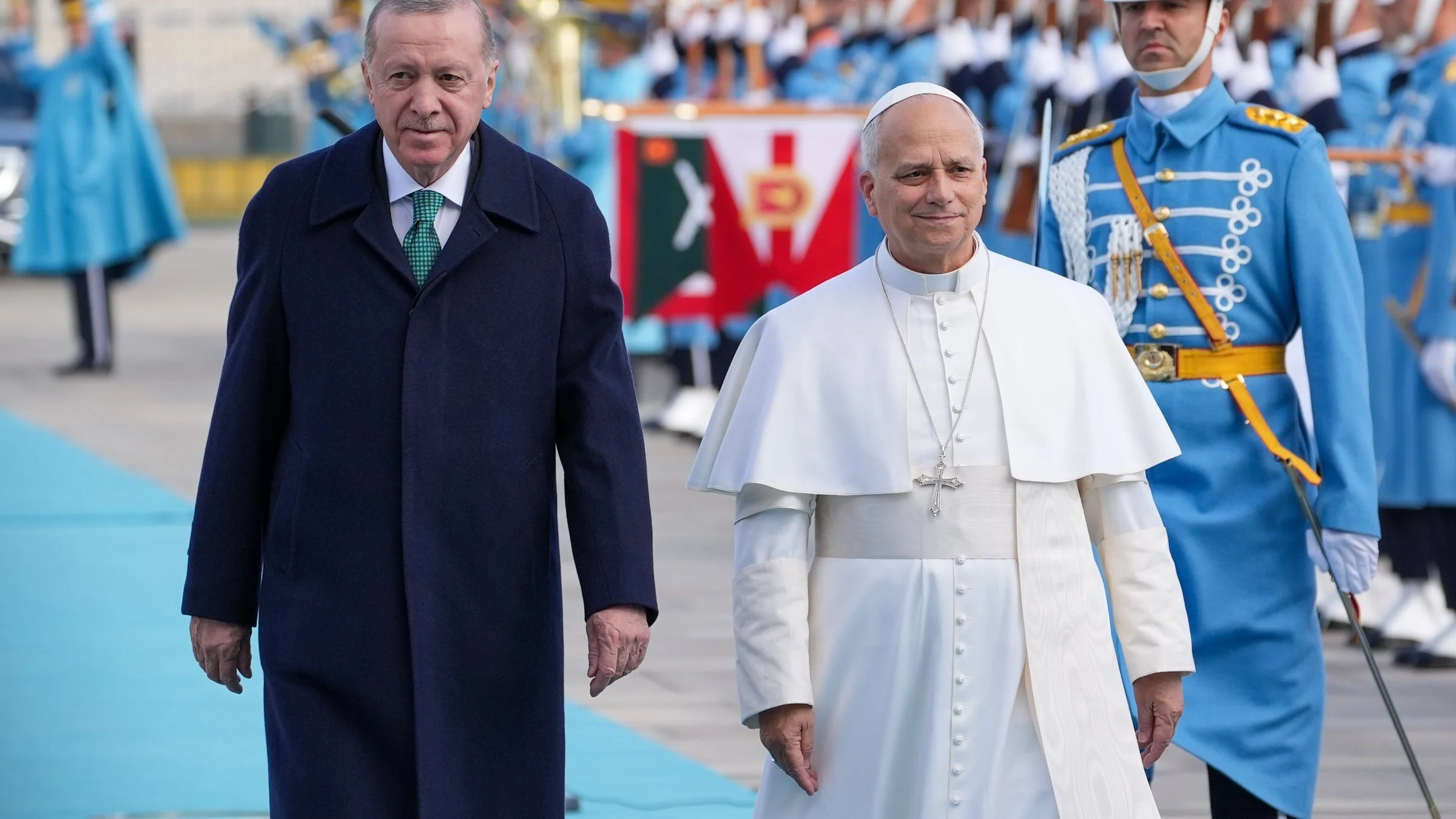
We end our 17th season with a look at the current state of the Catholic Church, as well as with a look at what we've been watching, reading, and listening to lately
INTRO
Pax Christi Advent reflections: Entering the Night of Peace
Bad winter storms
The Accessorized Bible
SEGMENT 1 - The Pope’s first trip
Overview of the Pope’s visit to Turkey and Lebanon
The “filioque” controversy
Fourth Lateran Council of 1274
St. Bonaventure
In-flight press conferences
The Pope’s call for a Palestinian state
The Pope’s comments on Ukraine
SEGMENT 2 - The ongoing saga around women deacons
Overview of the issue of women deacons
Heidi’s article for Commonweal: ‘A Patriarchal Stalling Tactic’
Study Group 5 appears to be treated differently
Kate McElwee, from Women’s Ordination Conference
Discerning Deacons
The fraught history of Humanae Vitae
Phyllis Zagano
Ernst Fraenkel, The Dual State
SEGMENT 3 - Pop-culture roundup
Slow Horses
Task - They got it right
The Morning Show
The Great British Bake-Off
Stranger Things
Last Week Tonight
Derrida/Searle, by Raoul Moati
Mademoiselle Holmes
Only Murders in the Building
Shrinking
Wicked
One Battle After Another
The Long Walk
Bugonia
A House of Dynamite
The Post
All the President’s Men
Spotlight
The Report
Reality
The Nanas
God’s of the Upper Air
Tom Lake
TRANSCRIPT
INTRO
DAULT: Hello and welcome to the Francis Effect Podcast. My name is David Dult. I host a radio show called Things Not Seen about Culture and Faith, and I'm an assistant professor of Christian Spirituality at the Institute of Pastoral Studies at Loyola University Chicago. I'm here with my dear friends Heidi Schlump and Dan Harran.
Heidi is senior correspondent at Common Wheel Magazine. She's also an award-winning journalist and part-time faculty member at Loyola University Chicago. Dan is professor of philosophy, religious studies and Theology at St. Mary. College in Notre Dame, Indiana. He's also a regular columnist at the National Catholic Reporter.
Every couple of weeks we get together to discuss news and events through a lens of our shared Catholic faith. And this is our final episode of 2025. Sort of a bittersweet transition into the winter holiday, and then looking at whatever is coming in 2026. But for now, Dan and Heidi, welcome to you both.
Heidi. How have you been?
SCHLUMPF: I'm great. I've been snuggled into my house. For the last two days with this snowstorm that we got here in Chicago and much of the Midwest we came home early from our Thanksgiving trip to Wisconsin to avoid some of the travel nightmares that I know a lot of people who were flying. Experienced, Dan will hear about yours. But it was a lovely Thanksgiving and prior to that I had a nice trip to New York. I was out visiting some of my common wheel colleagues. Also had a chance to meet up with some folks from America. I. And I went up to Manhattan University where I saw the Dorothy Day exhibit with my friend Dr.
Kevin Ahern, and it was really amazing to see. If you have any opportunity to visit there, I highly recommend it. We just marked the anniversary of her passing on Saturday. Today, of course, or yesterday Advent started and I'm scrambling as I usually am at. The beginning of these liturgical seasons, except I was organized enough to ahead of time order my advent reflections from P Christi this year.
And I'm really excited about this. This booklet I'm just gonna mention, it's called Entering the Night of Peace, and it's by two people I know well, so Cameron Bellum and Flora Tang. So thank you to them. And kinda shout out if you haven't already figured out what you're doing for Advent, this might be a good thing.
So I'm excited but bittersweet about the end of this season. I know both of you guys have been traveling a lot. So Dan, why don't you tell me first about your travels.
HORAN: Yeah. Well, let me just also say I, I'm aware of that Advent reflection book too, from Pax Christi and Flores a good friend as well. So shout out to them and their great work here. Yeah, I'll spare all of our listeners the 24 hour saga. I was in upstate New York for Thanksgiving. We got hit with what is just normally standard kind of, lake effect snow in the north country of New York State on the day, a Thanksgiving over to the day after Thanksgiving.
So that was kind of nice to hunker down with my parents after spending the day in Rochester, New York with my brother and his family and my other two brothers and their family. So it was really nice to get everybody together. But what that. Led to was waking up on Saturday morning when the plan was to travel back to South Bend via Chicago, and you can see where this is going.
And saw notices that flights were canceled basically the whole day. The good news was I was able to, you know, get a flight to Chicago kind of right as the worst of it was coming in. So I was able to get outta New York State but then had to rent a car to start driving back to South Bend. And it was, there was no way to make any kind of connection for the next 24 hours.
And it was really bad on 94. So I made it about halfway here and then realized it was too dangerous to continue. And that's coming from somebody who did his road test at 16 in a blizzard in Utica, New York, upstate. So I am, I'm very well versed in traveling and heavy snow and near whiteout conditions.
And it was too. Too difficult even for me. So, I saw one too many tractor trailers slide off into the ditch and people, you know, one person I saw leave their car in the middle of the highway and try to run to the side. I mean, it was just praying that she didn't get hit. So, I mean, it was pretty bad out there.
So folks who've been seeing the news nationally and see things like the FA. FA, a canceling flights, you know, it's very serious. And being on the ground, it was very serious back in South Bend. Like Heidi, I'm sure in your family, a lot of staying out of the cold, but having to pop out every now and then to shovel.
I will say that my three-year-old Husky named Ron loves the snow and she is in her best element out there. Her human who is not as you know, I guess. Warm as she is with her husky, Siberian husky coat. Doesn't appreciate it quite as much, but at least she's having a blast. Other than that, a lot of, you know, snow shoveling and and the like.
You know, the other thing of note was being at the American Academy of Religion, as we kind of highlighted in our last episode, and meeting up with our dear friend here, David Dolt. We had lunch together and caught up a bit, which was nice. It was especially cool. One of the. Kind of rites of passage for religion scholars, regardless of your field, is to go to the a a R and go into the exhibit hall and see your book, especially if it's your very first book in print with your publisher's display.
And I, this might be a good way to tee up David, to see how your last two weeks were, because I was so delighted to see your book at Yale University Press the accessorized Bible order it now from wherever you get great books, folks. But that was very cool. So David. Maybe you can tell us about your a r and Thanksgiving.
DAULT: Wow. So I'm so grateful that you managed to get home safely and having driven in adverse weather conditions, I know exactly what you're talking about. And yeah, discretion is definitely the better part of our. So I'm glad that you all made it home safe. Yeah. It was a real wonder to walk to the.
Exhibit hall and at first the exhibit hall was sort of split into two sections, which was a little confusing at first. So I, my initial experience was walking the entire, of what I thought was the exhibit hall and not seeing the Yale booth and thinking, well, they're just not here this year, and so there's no chance of seeing my book.
And then somebody said, you know, there's another half. And so I walked through this narrow hallway and got a, apparently to the cool side of the exhibit hall where there was in fact the Yale booth. And I had the chance to see my book sitting there at the exhibit. And that was a delight. And I also enjoyed very much Dan walking around with you to the various stalls where you have many books with many publishers and getting a chance to see each of them sort of being fans of you and your work.
And I always enjoy how. Having a chance to be in the edge of that glow because it's just it's a wonderful thing to see all the scholarship that you have brought into the world as well. And I continue to benefit from it in my projects. And so, but you know, I had a chance to meet with my editor Jennifer Banks from Yale.
And she said that there was a lot of good interest in the book at the stall, which was wonderful. And also the happy news that they would. Like for me to keep sending them proposals and the fact that it took 14 years to write this one didn't dissuade them from wanting to work with me again.
So I am looking forward to continuing that in the new year. And I have already a project that I'm gonna pitch to them. Then, you know, the rest of the. Of the a a R was really wonderful. I ran two sessions for the organization that I'm the president of and we had the chance to celebrate our co-founder and he was, I think, pleased with what we put together for him.
And I had a chance to meet with other colleagues who want to work with us on putting together stuff for next year and sessions for next year. And so all of that was good. And now coming back home I, like you have been shoveling snow and we're coming up this week on the last class session that I have, and then my semester will be done and I'm looking forward to that as well. I sort of had a little bout of senioritis for the last few days sort of with a Thanksgiving holiday. And now I have to get my act together and and teach one more class and wrap things up.
Or actually two more classes and wrap things up. And then ready for the winter.
HORAN: David you mentioned you know, all the wonderful things at the aar and I think it would be remiss if we didn't acknowledge that a number of people mentioned the podcast gave us shout outs and said in particular to send our regards to you, Heidi. So there are too many actually to name, which is a wonderful problem to have.
But it seemed like every reception I went to from a range of universities and publishing houses to conversations with colleagues and strangers that you bump into who see the name tag and say, ah, I love the Francis Effect. So, we appreciate all of you, especially those of you who are colleagues in the guild of a scholarship around religion.
And for those who aren't, you know, we love having all of you be part of this community that has organically built up around the three of us talking about all kinds of things. So, thank you for your continued listening ship or listenership, I think is the way it goes. And we just wanted to make sure to acknowledge that we've, we, we hear you and we appreciate you.
DAULT: Speaking of all the things that we talk about on the show today, we're gonna be diving into three topics. The first is the Pope has just taken his first official trip. Of his pontificate, and we're gonna be unpacking that and what it might mean moving forward and how it might move forward, the legacy of Francis in certain ways.
In our second segment, we're gonna be looking at the continuing saga of the discussions around women deacons, particularly around the so Noal process and some recent events that may have, put some obstacles in that path and what might still be some ways forward in that conversation. And then in our third segment, as has often been our habit at the end of a season, is we're gonna do a pop culture roundup where we're gonna be talking about what we have been watching, reading and listening to over the last several months.
So stay tuned for all of that. You're listening to The Francis Effect. Please stay with us.
SEGMENT 1
HORAN: Welcome back to The Francis Effect. I'm Dan Harran, and I'm here with David Dolt and Heidi Schlump. Every couple of weeks we get together to discuss a variety of topics from a perspective informed by our Catholic faith as we record today. Pope Leo the IV is in the midst of his first official trip as the Roman Pontiff.
He's traveling to the Middle East for six days, visiting Turkey and Lebanon. The trip is being characterized as a pilgrimage of peace. On the flight to Turkey, Pope Leo said to reporters on the plane that quote. We hope to announce, transmit, proclaim how important pieces throughout the world, and to invite all people to come together to search for greater unity, greater harmony, in spite of differences, in spite of different religions, in spite of different beliefs, unquote.
During his trip, the Holy Father met with secular leadership, including President Erdogan in Turkey and President AAN in Lebanon. He also prayed at both churches and mosques. These prayers included leaders of different Christian denominations as well as different faiths, including Muslims and Dru.
Perhaps most significantly, Pope Leo participated in a commemoration of the 1700th anniversary of the Council of Nsea. He joined ecumenical Patriarch Baral, the spiritual leader of the world's Eastern Orthodox Christians, amid the archeological ruins on the shore of Lake Isic, where bishops met in 3 25 of the common era to resolve theological divisions that threatened to tear the early church apart the next day. Patriarch Barolo Mule and Pope Leo signed a joint declaration pledging to pursue full communion between their churches and to advance efforts toward establishing a common date for Easter. Pope Leo emphasized that a restoration of communion, quote does not imply absorption or domination unquote, but a full exchange of their gifts with each other.
David, we're only scratching the surface of some of the many themes that have surfaced during this trip. Where do you think we should start discussing it?
DAULT: Well, I think first of all, the. Commemoration of the Council of Nsea is an important touchstone for us to be thinking about. We're at a point where. For want of a better term, the Christian world is in continued fracture, and that's a fracture along the lines of the great cism of 10 22, where the eastern, what we now call the Eastern Orthodox churches and the Catholic church split off from one another.
It's in a continued cism with regard to, global Protestantism in its various forms, there is overall hostility between many factions of the Christian churches and Christian communities around the globe towards other Christian churches and other Christian communities around the globe. And so that I.
Is a reminder that going back 1700 years, we had a similar set of systems and fractions in 3 25 around various interpretations of Christianity that were healed in some ways I mean it's a complex history, but healed in some ways by the Council of Nsea. And so if nothing else, the council of gave us a common set of statements that we make about the faith that a majority, but not.
All those that identify themselves as Christians utilize today, these known as the nicean in Constantin, openly and creeds. And so I think returning to the geography, the space where this healing happened with an attempt to try and bring together leaders of the global churches at least leaders of the global churches.
That, that were part of and are sort of inheritors of the great cism. I think that's an important move and I think that it really is carrying on a legacy that was that was definitely important to the heart of Pope Francis during his pontificate. And so, I mean, these sorts of set the stage for this, going into the heart.
Of geographies that are in conflict like Lebanon right now is sort of in the midst of war and war preparations but also going into the heart of Christian conflict and speaking. Peace as the kind of ringing bell message that he wants to bring and. So I'm interested to see what the fruits of this are.
I'm interested to see I was especially interested in the statement that you highlighted in the topper where it's like we're not trying to talk about absorption or having something disappear in terms of its identity or its character, but rather gifts being brought to gifts is what we're talking about when we're discussing reunification.
That to me seems very synod. It seems to me to be in the spirit of what we would like to call God's extraordinary variety or the idea of walking together without erasing each other into into unification to quote one of the, one of the bishops, and I forget who it's it's unification without necessarily erasure.
And so all these things are important pieces of the puzzle, and I'm interested to see what the fruits of it are. But I'd love to hear what you two think.
HORAN: So I think, I mean, there's so many great points that you've raised for us, David, and this, I love this line of unification without erasure. I think there are models for this even within the east, eastern, and western churches today. And we see this in part with the 20 plus Eastern churches in full communion with Rome that are considered Roman.
Catholic Right, but are not of the Roman. Right. So we might think in India, the Sir Mbar, or we might think of you know, many of the others throughout the Middle East and kind of Greek traditions. And what we see here is the maintenance of distinct rights, right? Including language practices or disciplines as it's called within Canon law. So famously in these other eastern traditions that are in full community with Rome, right? So, this is not a matter of schism between traditions. They're fully recognized in full community with Rome. Many of those particular rights do.
Do not require mandatory celibacy for their presbyters, for their priests. And so you have married clergy as a norm in these traditions. It's a little bit of a different setup because the eastern traditions tend to elect bishops from monastic communities in which there is the kind of presumption that, not the presumption that is the practice of celibacy.
And when I say presumption, the presumption of the evangelical councils, these three vows. So bishops typically are not married in the Eastern. Rights. But nevertheless, this is something I think that a lot of Latin Christians or Roman Christians of the Roman rite would be surprised to hear, right?
We see these exceptions in the Latin church where you have Anglicans or in some cases Lutheran pastors being emitted into full communion and then their ordination is recognized or they're re ordained and they may be married and with a family already. But this is not an exception. This is the norm.
So these are things that, you know, to your point, David, there's unification without erasure. A lot of the discussion about what does it look like for east and west to come back together after a millennium of separation. You know, on the one hand there's the kind of. The practical dimensions, some of which include these disciplines that we're talking about.
But I think we have a path for that. The other thing that's a little bit stickier is the kind of accretions of theological difference. And so we see this, for instance, in that creed that celebrated, you know, in, in it's foundation in EA and then later developed in, in Calcine and Constantinople, as you rightly mentioned.
But one of the things that we say in the Latin West, in the ni, the ene creed is known as in Latin, the Philly Oak Way, right, which says that the spirit proceeds not only from. God the father, but also the son. And this may seem like no big deal to a lot of people, but there are theological implications that follow from this.
Just a little sidebar, I can't resist putting on my professor hat for a minute. In Franciscan spiritual tradition hat, which is that in the fourth letter in council in 12 77 or excuse me, in 1274 there was this effort, you know, one of many over those. Centuries following the break east and west to try to bring unity back together.
And one of the kind of principle theologians that was making a case around this question of the procession of the Holy Spirit in the Trinity was St. Bonaventure who was a former minister general of the Franciscan order, a great theologian at the University of Paris, and he was made a cardinal to go to this ecumenical council in Leon.
To try to argue for a theological case to bring east and west together around this Trinitarian divide. So this is something, well in the works, I think there's a lot of good faith, particularly among ecumenical theologians and ecclesiologist. But it'll be interesting to see what comes of this, Heidi?
I mean, what are your thoughts?
SCHLUMPF: Well thank you to both of you for putting the whole Council of NAIA part in some good contemporary context for me. 'cause I was finding it hard to get excited about that celebration that I knew was coming up. What I, as a journalist was most interested in about this trip is wood Pope Leo, like Pope Francis.
Do those in flight. Press conferences that he had, that Pope Francis had kind of started that tradition. And I did see a number of posts on social media on the first leg of the flight to Turkey where, which was on Thanksgiving where a lot of folks were. The journalists were meeting with Pope Leo.
He came back and said hello to people. One, even gave him a pumpkin pie for Thanksgiving. And then on the trip from Turkey to Lebanon he did take some questions and to me, the things he talked about in that press conference were very interesting. So they were, and about very present day issues that are that are.
Very newsy again today. So saying clearly that the support for a two state solution between Israel and Palestine and then saying. Israel doesn't seem to be that supportive of that. I, that was obviously the news that most of the journalists led with from that mini press conference, but he also talked about the peace process in Ukraine and you know, kind of the problems with how that's processing and just the news from our own country.
About how the Trump administration is wreaking havoc. Havoc in that pre, in that peace process siding with the aggressor and giving all the spoils to, to Russia to probably benefit billionaires. In the United States and elsewhere is concerning. So I was grateful to see not only the things Pope Leo said in his official speeches on the ground, and there'll be probably be one more press conference on the way, you know, back from Lebanon to Rome.
And it'll be interesting to see what he says there. 'cause everyone has talked about him being more cautious in his personality. But it does seem that he's also still very forthright and open with the media.
DAULT: I had a moment over the weekend. Prior to recording this, that, I was reflecting on my initial ambivalence about Pope Leo and I found myself moved to tears actually, by the way that he has chosen to be a strident voice, not only for peace, but for the downtrodden and speaking in a very clear register to the times that we are in.
And, you know, I had very much hoped. That he would be an heir to. You know what I loved about Pope Francis and what I'm discovering is that in his own way, he is translating the Franciscan tradition. By that the papacy of Francis into the contemporary moment. In ways that both are consistent and coherent with what Francis was laying out, but also in ways that have surprised me again and again, and I'm still cautious because we're still early in all of this, but I just want listeners to hear that, you know, you've heard me be ambivalent about Leo in episodes past, and I want you to know that.
The stone of my heart is softening on this front, and I am, I'm judging by the fruits that I'm seeing of the papacy, and I'm excited at the possibility that this might be the kind of global moral voice that I have so wanted the Catholic Church to be. And what I saw in Francis and what I had.
Feared would be eliminated in a new papacy. Seems to be continuing. And so I just want to say I'm pleased with what I saw and all the things that you mentioned, Heidi, where he's taking these ancient from 1700 years ago, and he's recontextualizing them into, as you said, the modern conflicts that we have.
There's a deep spirit here that I'm observing and I'm grateful for.
HORAN: I'm wondering what you all think about what has been highlighted as one of the maybe departing actions or lack of actions in Turkey that was different from his predecessors, including Benedict the 16th and Pope Frank. Which was when he went to the Great Blue Mosque and did not kind of opt to publicly take a moment of silence or offer a prayer, even though he was welcome to, he was invited by religious leaders who were there on the ground.
Benedict the 16th in 2006 did that. He prayed silently beside one of the imams there. And then Pope Francis offered a silent prayer when he visited some years back. It's true that Pope Leo took off his shoes as a sign of respect, which is a practice of course, in these holy places. And but really didn't make a kind of public display of this.
Are, should we read into this? Are there thoughts? It's interesting to see continuity in the two previous popes and then a sense of discontinuity here.
SCHLUMPF: So I saw the reporting that mentioned that from that visit. And I was thinking about the many times that I've been in other houses of worship from other religions and you know, participated to the extent that it seemed appropriate or that I was welcomed to, and how those have been deeply spiritual.
Experiences for me, and also exposure to how people pray differently. But I also wonder, and I don't know the answer, I guess is to your question, Dan, except I wonder how it, you know, it's tough to be pope where your every movement or not movement is analyzed. But surely he's a media savvy person and had to have known that this would, might be something that would be noticed that, like you said, it was different than the two previous popes who made similar visits to mosques.
So yeah, I'm not sure exactly what it means. It certainly was notable and for me I've always felt comfortable praying in other houses of worship, but I'm not exactly sure what it means.
DAULT: So like Heidi, I cannot pretend to know the mind. Of Pope Leo here, but I do want to give a kind of generous reading in the wider context of ality and so, so much of the role of Bishops and the Bishop of Rome historically in the last 2000 years has been the role of. It's his job, always his job to end the conversation.
And so if we think about, for example, the context of the Nicean Creed that was ending the conflict and saying definitively, okay, we will hence forward in unity, say this. And that was an example of unity with erasure or unity with uniformity, if you will. Ality the sort of practice of the Church of the third millennium invites us into a different way of thinking about conversations where it's not about stopping the conversation, but rather it's about creating the space for the conversation to continue in a healthy way.
And I am, I'm continually in my writings trying to invite the leaders of the church to reimagine themselves in this register. That it's not your job to shut the conversation down. It's your job to make sure that everybody in the conversation stays safe and that the conversation can. Continue. Well, sometimes that means not being the center of the conversation.
Sometimes that means not making yourself a protagonist among other protagonists, but rather stepping back and witnessing the protagonist of others. So my generous reading of that moment is that it was a synod action as opposed to a hierarchical one. He wasn't placing himself on a pecking order, but rather he was supporting the conversation that was going on in his presence, and he was praying for that conversation.
That's the way I choose to think about it.
HORAN: I think those are interesting points and good ones at that. I, one thought that I had though kind of from a theological perspective and a kind of inter-religious perspective is, you know, our shared Abrahamic. Faith. One of the things that's quite powerful when you look at somebody like Benedict the 16th and Pope Francis taking an opportunity at the invitation of their Muslim siblings to pray to the same God that we worship, sends a signal to the Christian community especially in an age of rising Islamophobia and polarization, that actually we are siblings to one another and that you know, that Jesus and Mary especially have a very.
Important place in the Muslim tradition. They play a key role as prophetic figures in the sacred Koran. And we see this heritage as well that unites us to our Jewish siblings in this Abrahamic tradition. So I think, you know, one thinks for instance of Pope John Paul II's very powerful image of praying at the Western wall in Jerusalem.
So I hear what you're saying, David. Those are good points about not centering oneself, but when you already are, as Heidi said, the center and the object of scrutiny. You know, we are all responsible to kind of say and do things the, in a spirit of maybe subsidiarity at the level in which we find ourselves.
And so maybe I might put myself tentatively again, I don't know all the reasoning and pope. Leo did not give a kind of robust explanation. What we heard came from the side of the Muslim c clerics in in, in, in the mosque. But I would just say that I think it might've been a missed opportunity to show in a concrete prayerful and reflective way our shared worship of the same God.
SCHLUMPF: Well, maybe that's one of the questions that one of the journalists will ask on the plane ride home. We'll have to wait and see. But in the meantime, we're gonna wrap up this conversation, even though the trip is still happening as we're recording this on the, on. Monday. But so hopefully there'll be a little more news out of the trip.
But for now you're listening to the Francis Effect.
SEGMENT 2
DAULT: Welcome back to The Francis Effect. I'm David Dlt and I'm here with Dan Horan and Heidi Schlump. Every couple of weeks we get together to discuss news and events through a lens of our Catholic faith. During the Synod on Ality, Pope Francis created 10 study groups to handle the more controversial topics raised during the first assembly in Rome.
Those topics included the formation of priests, the selection of bishops ministry to LGBTQIA plus Catholics and women's leadership, including the restoration. Of women deacons. Now, those groups have submitted their interim reports and those reports have been released by the Vatican. Most of the interim reports noted the group's consultations and progress so far and anticipated that their final reports would be completed by the December 31st deadline.
However, study Group five, which was tasked with looking at some theological and canonical matters regarding specific ministerial forms, announced that the subject of women deacons would no longer be something they would be studying. The topic would instead be sent to the second women Deacons Commission created by Pope Francis.
Some listeners may recall that Francis created an original Women Deacons Commission in 2016. That group's report was delivered to Francis, but never made public. Francis then created a second commission in 2020. It is that group that will now take up the issue. Study Group five will now address the broader issue of women's participation in the life and leadership of the church.
In addition, several of the other study groups will touch on women's leadership, including the liturgy group and the one on seminary formation. Heidi, you spoke to individuals in groups involved in this issue. For a piece you wrote in common wheel. Is this is this move from study group to commission just a minor change, or does it mean something more?
SCHLUMPF: Well, I'm not really sure, and people I think are trying to remain hopeful that the discernment around the issue of women, deacons and women's leadership more generally, which was raised in every Continental report and the subject of much discussion at both of the Vatican Rome. Gatherings will not, you know, sort of die on the vine being sent to this other commission.
But it, it does raise some concern among people that this one issue is being treated differently than all the other issues. So, initially we had the. The spinning off of some of these controversial groups issues into study groups and being said kind of, well, we're not gonna handle this with the regular synod process that was happening with those two synod meetings in October of 2024 and 2025.
But then the idea was, well, maybe the hopeful reading of that was that okay, conversation about this would continue even after the ending of that process. And so in that respect, it was good to get the Synod interim reports, which I think were submitted to Pope Leo several months ago, but finally made public to see that those groups have been working.
But this study, group five, I've been keeping my eye on it. All along, it seems like it's been treated differently. So the names of the people on that study group were not made public. Unlike the other study groups which had a list of members and people they've consulted. There were some question about whether, you know, it was, the meetings were being attended by the top people from the Dicastery for the doctrine of the faith. And some concern and complaint from some folks about that last year. And then now to see that this issue is being spun off again and separated from the official synod.
Study group process and now being sent to this commission. So another one of the concerns is that this, the whole commission process around the women deacons, you know, a lot of enthusiasm and optimism around that for first creation of that first commission and, our, you know, friend to many of us Dr.
Phyllis Zano, who was on that commission and an expert many other theological experts on that first commission group. And then the frustration of Francis not really seeming to act on or make public the results of that. Commissions work and instead to create this second commission, which, you know, I don't want to, you know, say anything about any individual member, but as a group, the members of that second commission seem to indicate, I think one person put it that, that they might be moving in another direction with these commissions.
So. Now this is being returned to that commission, which had kind of disbanded. They also sort of finished their work and sent some report to the Pope, which was not made public as well. Now they're being reconstituted to have the be dealing with this issue. You know, within the movement of folks who are advocating for women's ordination to the diaconate, some were very concerned.
Kate McElwee from Women's Ordination Conference said. It, this is like a patriarchal stalling tactic. Other folks, including people from Discerning Deacons and Dr. Zano herself, are trying to stay positive and move forward with their work to continue to either, you know, do the work of deacons even if they don't have the titles or continue pushing for this.
But I think it is reason for some concern. I hope I'm wrong about that. What do you guys think?
HORAN: Well, just on that note, I would say you. Know, as the expression goes, committees are where good ideas go to die. And so in terms of, you know, it might strike some listeners as a bit harsh to talk about a patriarchal sort of stall tactic, but I we've seen this kind of thing before, sadly. And probably the most famous example goes back to the late sixties and the church's commission on the use of contraception, right?
Which included married lay people who and several bishops and theologians. The. Commission, which we know after the fact recommended to Pope Paul the sixth one thing, and in the end he opted to do the opposite. Something tells me that there's a little bit of concern about that. There's a sort of Schrodinger's decision here, which is like, you know, as long as they keep it in.
In a super state where you have, it's both going to go forward positively and going to go forward negatively, then nobody's happy and everybody's happy at once. And I'm, I apologize if I sound cynical, I admire the great work and optimism of people who are advocates like Casey Stanton and her colleagues at Discerning Deacons and Dr. Phyllis Ano you know, a great historian and researcher on this topic. And as you said, Heidi, a member of. Pope Francis's first commission.
By the way, I happen to see both of them at a a r, so shout out to them both. But as somebody who, you know, is taking a sort of broader look at this, I, I can't help but agree with you, Heidi. When I say that it does look concerning to move this out of the ordinary synod process, if it is indeed odl, where we're listening to people, we're embracing subsidiarity, where we're hearing the voices of all people by virtue of their.
Universal dignity, right? And vocation to holiness as baptized members of the church, as much a member of the church as any delegate to the synod, as much a member of the church as any pope. Then what we, then I can't help but scratch my bald head and say, what is going on here? You know, and that was concerning to me in the second.
Citadel session in 2024 when these commissions were announced to me it, it seemed rather problematic that in effect things were being taken off the table in terms of an agenda. So, I mean, again I apologize for my perhaps sin cynical sounding remarks, but I don't see anything other than a stalling motion here because you know, I just, what else is there?
And I'll give Phil Sano another shout out. She had an article, obviously as a member of the commission. She has not spoken publicly or even privately to my knowledge about the internal kind of deliberations and so forth. But she has written a number of things, both scholarly and more more for a trade audience, for a general audience publicly about.
The history of women in the diaconate and the kind of clear theological and historical arguments for this, for the restoration of this. And I know that she has a forthcoming book that is, is Builds on a theological studies article that she published about a year or two ago. That looks at other commissions, not just the two.
In Pope Francis' time. But this is something that has been studied in the past and is in the archives of of the Vatican. So, I encourage people to, to check that out. Maybe we can give a shout out when that book is released, which I think is gonna come out in the spring or late winter next year.
But, you know, I kind of look at the data, I look at the research and I say, why are we waiting? I mean, I wrote a column last fall where I said, enough is enough. You know, the time is now. And yet here we are.
DAULT: Well, let me take your cynicism, Dan, and in good Chicago improv fashion say Yes. And so,
HORAN: second city lives.
DAULT: Part, Part of my sort of work as a philosopher in the service of the church is thinking about the structures that the church uses to govern or to appear to govern. And so I am pushed back by this particular set of facts into reflections on a book by.
A person who fled Nazi Germany and came and did work at the University of Chicago by the name of Ernst Frankel. And he wrote a very important and powerful book called The Dual State, A Contribution to The Theory of Dictatorship. And in that book he posits that there is a normative state where procedures are followed and everything applies to everybody equally.
And then he said that. Oftentimes when something is slipping into a more authoritarian or dictatorial model, you have the continuance of that normative state, but you have the emergence of something else that he called the prerogative state, which is where suddenly the rules don't apply. You are now governing by special cases and you say, well, this particular situation demands that we can't follow the procedures.
And so, you know, you can also trace this through the work of Giorgio Ban and the idea of the state of exception. But regardless of how you think about it, we are looking right now at a normative state. Prerogative state distinction. That is happening here with regard to women deacons and I really like the connection that you made with human I Vita as well the history of that where, you know, a process is followed and then suddenly there is a disconnection in terms of the results of that process.
And one wonders where this result came from. And it appears to simply have come by fiat rather than by actually. Listening and threshing all of the sort of input that is being given. And so we're seeing again that when there is the possibility of certain members of the church being supported in the dignified agency of their own destiny there are members of the church that want to come and say, well, we're gonna impose a dignity on you that we have envisioned for you, not one that arises from your own testimony about how you are working with the whole.
Spirit thinking about the census fidelium, but rather we're going to tell you in a very patriarchal and paternal fashion, we're gonna say, no, this is good for you. You can't choose for yourself. And to me, I have a lot of problem with that, but I just want to name it. I wanna name it.
HORAN: I think you're naming it well, David and I also think, you know, there is this very disturbing again. I think I wanna make a distinction here too that might be helpful between intention and impact. We talk about this in other forms of exclusion, right? Particularly when people are in power and people are in a powerful majority.
And in the case here, we may not have a majority of people, right? Actually it's quite small minority of church leaders, but they are exclusively male, right? And they are members of the clergy. And so there, there's an empower imbalance here and there is a speaking on behalf of others. I think the intention I want to.
Hold that the intention is in good faith that the bishops in particular and Pope Leo specifically want to do the right thing that they mean to do the right thing. But I wanna raise the specter of fear and I think that fear functions and did function in the sixties with Pope.
Paul, the six, I should say Saint Paul, the six now. And I think fear functioned both in the pontificate as it does with all human beings of Pope Francis and maybe to some extent in Pope Leo and his rather nascent ministry as Bishop of Rome. I think there is a fear. To rock the boat. I think there is a fear about backlash from bad faith actors, and what I would raise as a question for an examination of conscience is to ask those who are in positions of power here, who can make a decision, who have the theological and historical justification to do such?
To ask of what are you afraid? I think that, you know, the second question I would ask is the 19th century cliche, what would Jesus do? And Jesus who preached time and time again to, to do not be afraid, right? For us to to reject the irrational fear that gets in the way of Christian discipleship and practice what he preached to the point of the cross.
What Jesus did that got him to the cross was. Ever expanding the circle of those who are included. His going to the margins, his associating with people, him his doing things that religious and civil leaders viewed as disruptive or not traditional or not to be expected. And I think it's a disservice to the Holy Spirit, as you said, David.
I think it's a disservice to the gospel and to the people of God to let fear be that which. Has control of the dr the steering wheel, right? That's driving the ship as it were driving. I'm mixing so many metaphors here, but you get the idea and I can't help but see that fear is what's at play here.
Fear of disunity, fear of schism, fear of rocking the boat, fear of backlash. These are all things that are negative. They are primitive. They are not positive, nor are they prescriptive. And I think that if we take the gospel in Jesus seriously, if we take history and theology seriously. And I don't know that everybody does, right?
Because I think there are certain blinders on, there are certain kind of self-justifying narratives that are repeated in some of these hallways, in some of these circles that that don't take into consideration the full spectrum of truth.
SCHLUMPF: Well, I'll just name it too. I mean, fear, I know fear of schism and unity. Disunity is a big fear, but so is fear of women, sexuality, women's power. I mean, it just does seem like it's always issues regarding gender and sexuality that are these ones that get separated out into these prerogative type of decision making processes.
And I will say you know, I wanna. I want to also assume, you know, the most positive reading of things, but it does sort of seem like this was kind of sneaked in there too, into the point, to the point where some news outlets missed it and thought like it was kind of just part of a sentence in the interim report from Study group five, and I know.
I think the NCR headline initially said something about women deacons, and then it had to be changed because it became clear that, oh, wait a minute, they're actually moving that out of the process now. And then that was confirmed by someone from the study group or from the CDF or DDF, I'm sorry.
So, yeah, I mean, I think everyone is. Still hopeful that the best case scenario might be that at some point, who knows in whose lifetime the issue of the restoration of women, deacons might get moved to be a local decision. So not that it would be restored universally to the church, but that local bishops that could make decision about whether to do it in their dioceses.
But I will say. The impact, even if not the intention, is that this is just another blow to women. And not just Western women, but women throughout the world who were hoping for some swifter and more decisive movement on this issue. And I just, I'm always sad to have to report that. You know, I'm pro ality.
I'm wanting to be hopeful like you said, David, about about Pope Leo, even though I'm cautious as well, so it kind of saddens me to have to write this piece, but that's what people were saying behind the scenes, and I think it needed to be brought to the attention. And I'm both sad, but also gratified to see that.
You know, I think women aren't the only people who see it that way, that two allies such as you two gentlemen, see it that way as well.
DAULT: Well, this is not the first time that we have dealt with the slow progress towards revisiting the diaconate for women here on the Francis Effect, and I'm certain that it will not. Be the last. One of the things about ality that we often say on this program, and you've heard me say it throughout our seasons, is walking together means that sometimes the bishops are ahead of us in a moral sense, and sometimes we are ahead of the bishops and we trust in some ways that we are all heading towards the same place, which is the goals and the.
The landscape that is defined for us by the Holy Spirit. And so I would ask listeners if you are currently ahead of the bishops in your diocese. Continue to do what you do. And if you are feeling the call to step out boldly and know that we are in solidarity with you and that the spirit is in solidarity with you and, invite continually the leadership of the church to catch up with your prophetic witnesses. And so with that, we're gonna turn from this topic and move into our discussion of the pop culture roundup. That's gonna happen in just a couple of minutes. You're listening to The Francis Effect. Please stay with us.
SEGMENT 3
SCHLUMPF: Welcome back to The Francis Effect. I'm Heidi Schlump and I'm here with David Dld and Dan Haran. Every couple of weeks we get together to discuss a variety of topics from a perspective informed by our shared Catholic faith. Well, we've reached the end of the 17th season of the Francis Effect. We've spent the last few months looking at issues facing our nation, the highs and lows of church life, and various crises from around the globe.
While we sometimes have exciting and positive stories and events to discuss, we often find ourselves engaging difficult topics. As important as all those things are, it's also important to do a bit of self-care and even a bit of mindless distraction.
So as has become our tradition, at the end of a season, we wanna take some time to share what we've been reading, watching, and listening to lately in a segment we call our pop culture roundup. So Dan, why don't you get us started? What's been on your entertainment and pop culture radar?
HORAN: Happy to this is one of my favorite segments every season, and so I know we have fans of the podcast who look forward to it as well. Well, let me start with a confession, which is because my day job requires a lot of reading and I've been. Really swamped with deadlines and obligations and book projects that are long, long passed, overdue.
I have not been doing a lot of reading for pleasure, so I'm just gonna state that from the outset, maybe the two of you will have book recommendations that you can provide whether fiction or nonfiction. But I'm gonna, I'm gonna plead the fifth there on that front, but I have been watching a fair amount of TV and some.
Some movies regular listeners will know that I am a completionist when it comes to the Oscar best picture nominees. We're still a few months off from that, but I've been trying to watch a number of movies that I think will be contenders. And so I'm happy to talk about that as well as a couple documentaries that I wanna recommend, but maybe I can start with TV shows.
'cause I think this is the thing that both unites and divides us the most. So let me just name a couple shows that I've watched. This. Recently, this past season that I really like. And I'd be curious to see what you two have and as well. So, for better or worse, I actually have many more.
But here are some three really great ones. The number one on my list is Apple tv. Slow Horses. If people haven't seen that, it is just extraordinary with Gary Oldman and a whole cast of just extraordinary actors. It takes place in England, if you like, kind of detective mystery sort of stuff, or MI five.
You know, CIA sort of operations if you like, comedy and humor and at times silliness. It's got it all for you. So big fan of slow horses looking forward already to, to the next season. A show that came out of nowhere I, for me, that I really appreciated was a show on HBO or HBO Max or Max Plus or whatever it's called today called Task.
And this star starred Mark Ruffalo. It was of interest to me for a number of reasons. One of which was that his character was a former Catholic priest who had left ministry many years earlier. Eventually got married, became an FBI agent. Had a mixed family you know, some biological children, some adopted children, and some with some very special needs.
I don't wanna give too much away, but it was a very moving show. There's kind of mystery and drama about a task comes from the task force that he heads up. From the FBI looking into some drug crimes and gang crime related things. But I have to say as a theologian, as somebody who you know, has left active ministry in religious life and an ordained life they got.
Hi. They got the Catholic priesthood and Catholic theology. Exactly right. And I remember watching, maybe it was episode two or three, the show runner was a talking head kind of talking about that particular episode and he acknowledged that he had an uncle who was a former priest. And so I wonder if there was some kind of advice there, but it's very rare to see.
Catholic priests depicted correctly in popular TV shows and movies let alone somebody who has left ministry. Well done. Super, well done. Great show. The morning show on Apple TV is another program that I've watched. I see Heidi nodding. I'm be curious to see your take. I think it's needs to end, and I say that lovingly.
I like the show, but it's losing the edge. It had the first two seasons, I'll just say that. And then my fourth. Sort of recommendation which is nothing but a feel good experience, which is the great British Bake off. And so, that is when things are going crazy and the world's falling apart and you have a stack of papers to grade, but you have no brain cells functioning, you turn that on and it is delightful.
So, what are on your lists? What are you both watching?
DAULT: Well, I want to pick up with task and if you're familiar with the Mayor of East Town and watch that it's made by a similar production group that brought us mayor. Air of east town like you, Dan, I was really gripped by that, like at first at with all sorts of things. When it's establishing its world, it's a little rocky but by the time we got into the third and fourth episodes my wife Kira and I were really gripped by it.
And it, it really has some moments where you will find your. Cheering and moments where you'll find yourself in tears. It's a very powerful I also want to give in terms of like television. So my wife, Kira and I, we went back and we rewatched the entirety of Stranger Things in anticipation of the, the dropping of the first part of season five. And so we have now watched all of those four seasons plus the little nugget of season five that we got. It is an uneven show. I will say that the first season of Stranger Things is just remarkable. And particularly Millie Bobby Brown is just a revelation in that first season in terms of the ability with both silence and rage as an act.
To sort of convey things at so young in age watching all of them mature and move through the problem of, you know, four years of diegetic time within the show, nine and a half years of actual time with the actors. It gets a little rough and rocky at certain points, but if you have the time to indulge, it is worth going back.
There were a lot of things from the first watch through that we just didn't remember because the timeframe was so long. In addition to that, I wanna also give a shout out to last week, tonight the John Oliver Show. And as usual, John Oliver continues to be knocking it outta the park with regard to social commentary.
And there was an interesting crossover in one of his most recent episodes where he was talking about public broadcasting and one of the. People that he used as a consultant on the show is an acquaintance of mine by the name of Joshua Shepherd, who came out with a really wonderful book called The Shadow of The New Deal a couple of years ago.
And I've had good conversations on things not seen with Joshua Shepherd about that book, but he was given a shout out by John Oliver on air for the aid that he gave in terms of sort of helping them come to grips with the the history of public broadcasting.
HORAN: Can I just give an amen to both of those? David, I know in. Ar we were talking about Stranger Things and eagerly anticipating that Thanksgiving drop. I am also fully caught up at this point and did the same thing a couple months back. Rewatching all the seasons up to this point and it, I agree with you, it's uneven, but it's and overall really great.
Also, love John Oliver. That's a service to humanity, that program.
DAULT: So I just, I wanna shift gears slightly and say I've recently acquired a copy of a book by Raul Maori, who is from university of Chicago, and it's a book called Deida and Surl Deconstruction and Ordinary Language, which is a history and a revisitation of my all time favorite book of philosophy, which is ADA's Limited Ink.
And the feud that happened between Jacques Deida and John Searle. So when we talk about books, I'll have more to say about that. But Heidi, what have you been watching?
SCHLUMPF: Well, let me just confession that I am one of those people who gave up on Stranger Things. I can't remember which season it was right after my nephew died. I just couldn't watch it and I never picked it back up. And you guys both saying it's uneven is not pushing me towards it. I don't know why I keep watching the morning show.
I think that's something I kind of hate watch as well. I will say, I have not yet watched the Revolutionary War documentary, but my husband started without me, so now I have to catch up. But what I've been watching is a couple of my usual British mystery shows, which I. My husband and I, it's something we love to do together and so we watch, have been watching this one called mare.
Mare. It's based, it's English speaking, but it's based in Paris. And then I also started watching one called Meta Well Homes, which is actually French with subtitles, but really good. And we also watched only murders in the building, which I also wonder if that's time for that to end too.
But I still love it. But the sneak show that I ended up really liking, and I'm only done with season one, is shrinking. I can't remember if either of you had watched that. Before. So I'd heard about it and it's one of those things I was like, oh, I'll just watch one of these on the plane.
And I love it. It's about these two this group of three psychologists and just their own lives and lives of their patients and it's just really well done and good food for thought. I will say one of the advantages of unemployment over the summer is that I did get to read a lot 'cause I wasn't reading as much for work.
So I have some books to share too, but I'm curious. Have either. I'm dying to know if anyone went and saw Wicked. I didn't. The wicked second. Wicked? No. None of us. Wow.
DAULT: Yet.
HORAN: no. I don't think I will. I didn't wanna see the first part except it was nominated for best picture and so I forced myself to watch it. And it's no shade to Wicked. I actually saw Wicked very early on in London in the West End performance, I think. I think it's a brilliant musical.
The music is great. But I think there is a little bit of this indulgence of two, three and a half hour long segments. My, my brother and sister-in-law were telling me that they took my niece, who's very into the wicked right now to see it in theaters and they had a good experience, but apparently there's a, there were newer songs or there's some sort of expansion.
But yeah, just in full disclosure, I'm not particularly interested in that.
SCHLUMPF: Well, the second one is supposed be. Shorter, I think not three and a half hours long. My, my daughter saw it as well and she thought it was better than the first, which is not what the critics are
HORAN: no,
SCHLUMPF: But I might leave that for something to do over the Christmas vacation. But and I also haven't been to the movie theater.
I can't even remember in how long I think of the, since I saw the Bob Dylan movie. So I don't know, did either of you see the Bruce Springsteen movie?
HORAN: not yet. No.
SCHLUMPF: we're too busy to go to the movie theater, I think is the problem.
HORAN: And if you wait long enough, it comes to streaming. I mean, I'm happy. I'll also say just a call back to your giving up on Stranger Things quid pro quo. I gave up on only more murders in the building. I felt like after the second season it just became repetitive. And so, we all have our favorites and some come and go.
But since, hi Heidi, you mentioned Wicked in movies. Let me just name a couple of the ones I've watched recently that are interesting and I'd be interested to hear what you are watching. Just four. One is one battle after another. The Paul Thomas Anderson movie starring Leo DiCaprio Benicio de Toro and so many others.
Too many to name. That's definitely got Oscar Buzz it. All these all but all three, all four of these movies rather have sort of, they're all allegorical. And I think this is something about the signs of our times. The serious movies that are coming out are reflections, both of history and present.
So you. One battle after another is actually an adaptation of a Thomas Pension novel. So this is quite old. It goes back quite a bit and yet it centers around what today we would call ICE and border patrol and immigration enforcement and torture and these sorts of things. And so.
Really very good. It's also about a father and a daughter and all of this, but I'll leave that. The the other is the Long Walk, which stars Mark Hamill in addition to other actors. Mark Hamill is Luke Skywalker, for those who aren't familiar with the actor's name. But this was based on a short story by by Stephen King, that was written.
Actually before The Shining, it was written back in the seventies and was really an allegory for the Vietnam War. I don't wanna spoil it. It seems it's marketed in some ways, like a horror movie. And I know I said Stephen King, but it's closer to Shanky Redemption and Stephen King's writing of that sort.
Very powerful. A little bit gory right off the bat, but then, you know, you kind of see where these things go. Highly recommend that. I just last night actually watched Begonia, which is Yago uh, Lanam Moses' latest movie. He's the director of Poor Things that started Emma Stone and Mark Ruffalo a few years ago.
This is in some ways equally weird, but an allegory I would say for the billionaire class in our Amazon era, you know, even though the kind of. Protagonist or antagonist to be determined. I won't spoil anything is played by Emma Stone, who is a sort of Emma Stone. Es like Jeff Bezos. So check that out.
And then last is a movie I recommended, I know to David and I don't know if you've seen it yet on Netflix called The House of Dynamite which is a Catherine Bigelow movie and is all about. The possibility of a nuclear war. So I'll leave that there. They're all, you know, very timely in their own way.
Kind of heavy movies. So if you're looking for Laugh Out loud comedies. I'm afraid I don't have much by way of film for you today, but what are you two watching?
DAULT: So I will just say haven't had much time for movies, but when we do Kira and I have a list that we go back to again and again, and I know that I've mentioned this before. We watch all the president's men, we watch the post we watch spotlight sort of in, in a row. And then we go on and we will sort of add to that.
And so there's a movie called The Report and there's also a movie called Reality, which is about reality winner. And so if you're in the mood for really excellent, sort of thematically connected, cinema. That's our go-to. And we probably three times a year, we'll go through that sequence and watch all of those in short succession with one another just because it is so still prescient and speaks to the times that we're in.
Heidi, how about you? What are you watching?
SCHLUMPF: Well, I haven't been to the movie theater and I'm trying to think, we, I often don't have time to watch a whole movie either in the evenings. I don't with my spouse at least. But when my husband was out of town, my daughter said, oh, let's watch a show mom, which. We don't do very often either. We're often all, all off in our own rooms with our devices.
So I was grateful she offered to do that. And we watched the something I'd heard about it called the Nanas. It's, it was about this guy that started the restaurant in New York where he got all Italian grandmothers to do the cooking. And I won't say it's the best movie I ever saw, but it definitely was heartwarming and a good show for parents and kids to watch together.
So,
HORAN: the one with Vince Vaughn?
SCHLUMPF: Yeah, I think, yeah, he's in it. Yeah. So I, I mentioned books and it's not like I've been reading, you know, a book every week, but I did read some really good books recently and I'm in the middle of one that I keep telling my husband, oh, this is so good. This is so good. It's nonfiction. It's called Gods of the Upper Air.
And it's actually a history of kind of modern anthropology and the subhead kind of says how a circle of renegade anthropologists reinvented race, sex, and gender in the 20th century. And this is just one of these lovely things where I'm in my neighborhood library and I just see it and the cover looks interesting and I pick it up and it's fascinating.
It's about Margaret Mead and her mentor and a group of other anthropologists, and it's just so. Well written and like a story that it doesn't even feel like nonfiction. And then before that I love anything Anne Patchett has written and I just picked up one of her novels called Tom Lake and went through that in a couple days and it was just lovely.
So I can highly recommend both of those. Have either of you read anything besides your own scholarly requirements that you would recommend.
HORAN: I'm gonna defer to David on this one. I'm pleading the fifth I.
DAULT: So I have gone back to a beloved collection of mine by James Joyce called Dublins, which is just a collection of his short stories. And if you've never encountered that book. Before you are in for a treat. It is just a fantastic set of stories that are timeless in many ways. And if you have the chance, and if you're with someone who's willing, take one of the shorter stories and read it out loud to that other person because the language is so exquisitely beautiful.
And it's one thing to read it with. The voice in your head, but to have it sort of come from your mouth and to realize that every word is so carefully chosen, I just, I can't say enough how much I love that particular set of short stories. So listeners, we'd love to hear what you are distracting yourself with this holiday season.
And so feel free to let us know. Also, just as we have said at many points in this episode and in previous episodes. It means so much to us that you listen and that you are on this journey with us sometimes ahead of us, and sometimes right alongside of us as we are trying to move in the wake of what Francis' legacy means for the church.
We're gonna take a couple of weeks of break and we'll be back in January for the next season of the Francis Effect, but for now, we wish you a very blessed advent and a wonderful Christmas. Please know that you are in our prayers and we ask for your prayers for us and for our families, but also as always, prayers for the poor and the least of these among us because everything that we do and everything that the church should do.
Should keep them first in mind. Thank you as well to Dan and Heidi for just your friendship and for all of the ways that we adventure together. I cannot wait for the conversations in 2026, but for now, you've been listening to The Francis Effect. We hope that you'll be back with us in the new year.